Surgical Lights for Operating Rooms: Complete Hospital Buying Guide for 2026
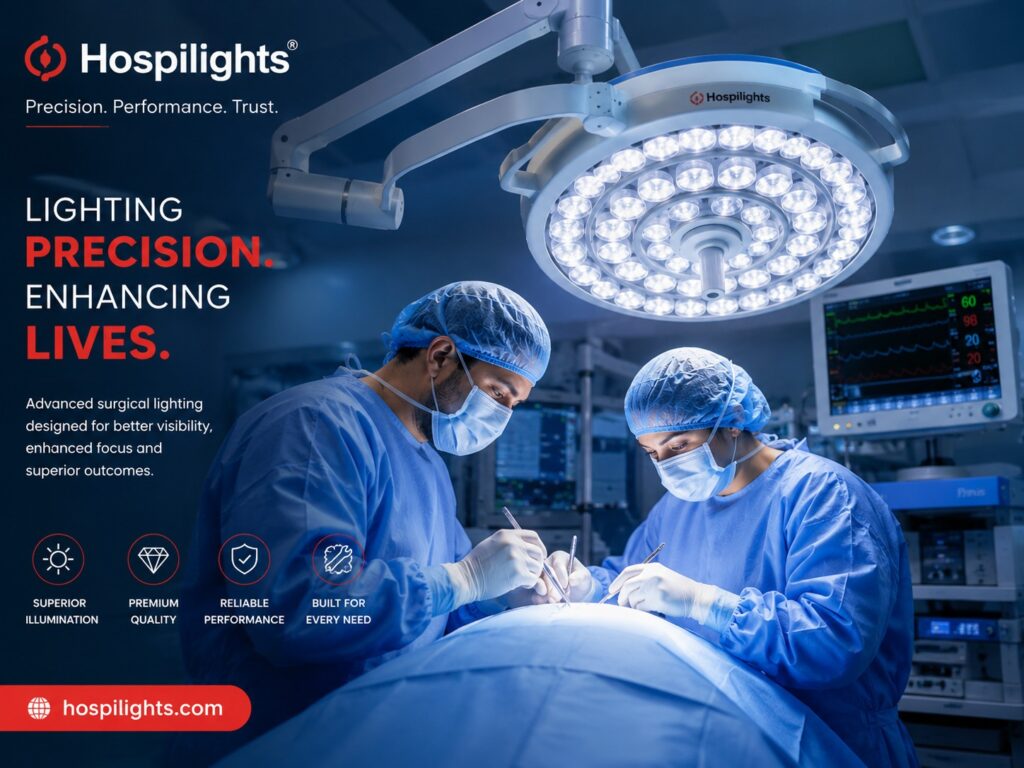
A professional guide for hospitals, surgical centers, and healthcare procurement teams to understand surgical lighting systems, operating room illumination standards, LED surgical lights, safety compliance, and how to choose the right surgical light solution for long-term clinical performance. Introduction Surgical lighting is not just another hospital equipment purchase. It directly affects: A difference of: can change how surgeons perceive: Poor lighting increases: Proper surgical lighting does the opposite. Yet many hospitals still approach surgical light procurement as a price-based purchasing exercise rather than a clinical infrastructure decision. That becomes expensive later. Because the cheapest light often creates: This guide explains: By the end, you will understand how to choose surgical lighting systems that support: because surgical lights are not simply lighting systems. They are part of the surgical environment itself. What Are Surgical Lights? Surgical lights — also called: are precision illumination systems designed specifically for surgical procedures. Unlike regular lighting, surgical lights are engineered to provide: Modern surgical lights typically deliver: 160,000–300,000 lux with: This enables surgeons to clearly identify: under demanding operating conditions. Why Surgical Lighting Matters More Than Most Hospitals Realize Surgery is visual work. Every surgical decision depends on what the surgeon can clearly see. This is why lighting quality directly impacts: Studies consistently show that inadequate OR lighting contributes to: A surgeon performing an 8-hour procedure under unstable or poor lighting experiences significantly higher physical and cognitive fatigue. This affects: Good lighting reduces those issues. The clinical impact becomes measurable over time. The Hidden Cost of Cheap Surgical Lights Low-cost surgical lights often create operational problems hospitals underestimate initially. These may include: What initially appears “cheaper” eventually costs more through: A surgical light is not a short-term purchase. It is a 10–15 year infrastructure investment. Core Technical Specifications Hospitals Must Evaluate Not all specifications carry equal importance. Here are the metrics that genuinely affect surgical performance. 1. Illumination (Lux Output) Lux measures light intensity at the surgical field. Modern surgical lights generally provide: 160,000–300,000 lux depending on specialty requirements. Recommended Lux by Surgical Type General Surgery 160,000–200,000 lux Neurosurgery 200,000+ lux Microsurgery & Ophthalmology 250,000–300,000 lux Orthopedic Surgery Around 200,000 lux with larger field coverage Higher lux improves visibility of: However, illumination quality matters more than raw brightness alone. 2. Color Rendering Index (CRI) CRI measures how accurately the light reproduces real tissue color. For surgical environments: CRI 95+ is considered essential. Why? Because tissue differentiation depends heavily on accurate color perception. Poor CRI changes how surgeons perceive: Lower-quality lighting may distort surgical interpretation. This is not cosmetic. It is clinical. 3. Color Temperature Stability Surgical lights typically operate between: 4,000K–5,000K which closely resembles natural daylight. However, stability matters more than the exact number. Some lower-quality systems shift color temperature as heat builds during surgery. This changes tissue appearance mid-procedure. High-quality systems maintain: Stable color temperature within narrow tolerances. This consistency improves surgical confidence. 4. Shadow Control Modern surgical lights use multi-source illumination systems to reduce shadows. Good shadow management ensures surgeons maintain visibility even when: Poor shadow control forces frequent repositioning. That wastes: and increases surgeon fatigue. 5. Heat Output Older halogen systems generated substantial heat. This created: Modern LED surgical lights significantly reduce heat generation. This improves: Today: LED systems are considered the clinical standard. LED vs Halogen Surgical Lights This is one of the biggest transitions in modern operating room technology. Halogen Surgical Lights (Older Technology) Halogen systems provide strong illumination but create major limitations. Limitations of Halogen Systems Bulb lifespan typically ranges: 500–1,000 hours which creates recurring replacement costs. LED Surgical Lights (Modern Standard) LED systems have become the dominant OR lighting technology. Why? Because they provide: LED lifespan often exceeds: 50,000 hours making them significantly more cost-effective long-term. Why LED Systems Are Worth the Investment Although LED systems have higher upfront costs, they reduce: over 10–15 years of OR use. This makes total ownership cost lower over time. Modern hospitals should focus on: LED-to-LED comparison. Not LED vs halogen. How Hospitals Should Choose the Right Surgical Light System Surgical light procurement should follow a structured evaluation process. Step 1 — Define Surgical Specialties Different procedures require different lighting performance. Hospitals should evaluate: before finalizing specifications. Clinical application determines lighting requirements. Step 2 — Evaluate Real Shadow Control Specifications alone are not enough. Hospitals should physically test systems with surgeons. Observe: Real-world performance matters more than brochures. Step 3 — Test Color Quality Surgeons should evaluate: Lighting quality directly affects surgeon confidence. Step 4 — Assess Reliability & Support Surgical light downtime disrupts operating rooms. Hospitals should verify: Reliable support matters. Step 5 — Calculate Total Cost of Ownership Hospitals often compare only upfront purchase price. That is a mistake. Total cost includes: The lowest purchase price rarely equals the lowest operational cost. Important Safety & Regulatory Standards Surgical lights are regulated medical devices. Hospitals must verify compliance before procurement. FDA Clearance In the United States, surgical lights are: FDA Class II medical devices. Hospitals should always verify: IEC 60601 Compliance This international standard covers: IEC compliance is essential for modern OR equipment. IEC 62471 Photobiological Safety This standard evaluates: High-quality manufacturers test systems thoroughly for patient and clinician protection. Common Surgical Light Procurement Mistakes Hospitals repeatedly make similar purchasing errors. Avoiding them improves long-term outcomes. Mistake 1 — Focusing Only on Lux Numbers More brightness alone does not guarantee better surgical performance. Poor: can reduce surgical quality despite high lux ratings. Mistake 2 — Ignoring Heat Output Poor thermal management increases: Heat management matters significantly during long procedures. Mistake 3 — Not Involving Surgeons in Evaluation Procurement teams purchase systems. Surgeons use them daily. Clinical feedback must be part of the evaluation process. Mistake 4 — Choosing Only by Purchase Price Cheap systems often create higher long-term cost through: Hospitals should think long-term. Mistake 5 — Ignoring Maintenance Requirements Some systems require: Others operate with minimal maintenance. Operational reliability matters. Why Hospi Lights Surgical Lighting Systems Stand Out Hospi Lights focuses on surgical lighting engineered specifically for: Their systems
Surgical Lights with Integrated Cameras: The New Standard for Modern Operation Theatres?
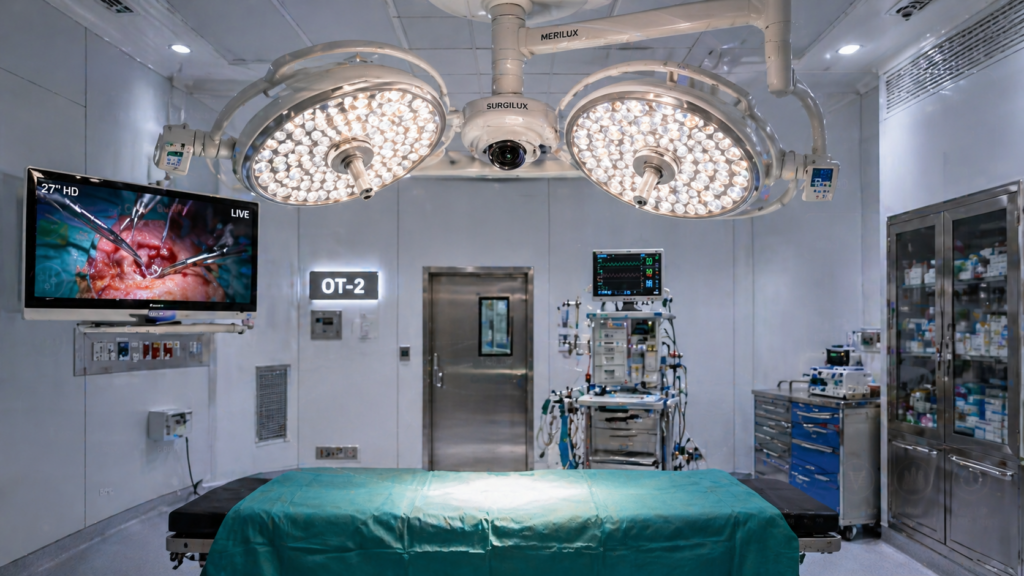
In the past decade, the definition of a surgical light has changed fundamentally. A light that only illuminates is no longer enough. Today’s leading operation theatre environments demand surgical lights with integrated cameras — systems that combine shadow-free illumination with real-time HD or 4K video capture, monitor connectivity, and remote documentation capability in a single ceiling-mounted unit. For hospital owners and clinic administrators making procurement decisions right now, the question is not whether camera-integrated OT lights are a good idea. The question is whether you understand exactly what to specify, which features matter clinically, and which are marketing noise. This guide answers all of that. It covers how surgical lights with integrated cameras work, what clinical problems they solve, which specifications to verify, and how Hospilights’ camera-ready surgical lighting solutions are designed for Indian hospital environments. What Are Surgical Lights with Integrated Cameras? A camera-integrated surgical light is an LED OT light that has a high-resolution camera built directly into the light head — positioned, ideally, at the optical centre of the light cone. This positioning is critical. When the camera sits at the centre of the illumination field, it captures exactly what the surgeon sees, with the same brightness and colour fidelity that the light provides at the surgical site. Cameras mounted off-centre or added externally create viewing angle mismatches that reduce the clinical value of the footage. The complete camera-integrated system typically includes three elements: Hospilights’ camera-integrated surgical lights follow this architecture. The Hospi Star 48+48 HD and the HOSPI PARIS 80+80 are available with an optional HD camera and monitor, with HDMI/IP connectivity and remote control — making them directly compatible with modern OR documentation and teaching setups. Why Hospitals Are Choosing OT Lights with Cameras Camera-integrated surgical lights are not a luxury upgrade. They address four specific operational problems that hospitals face every day. Clinical Documentation and Medico-Legal Protection Every surgical procedure generates a medico-legal record. A camera system integrated into the surgical light captures real-time, high-resolution footage of the operative field from the optimal viewpoint — the same viewpoint the surgeon works from. This documentation protects the hospital in the event of disputes, supports quality audits, and creates a verifiable record of surgical technique that standalone documentation methods cannot replicate. Surgical Training and Medical Education Teaching hospitals and medical colleges have used external cameras and endoscopic feeds for years, but these systems introduce viewing angle problems and setup complexity. A camera mounted in the light head provides a clean, overhead surgical field view that works for live observation on an in-room monitor, remote streaming to a seminar room, and recorded video libraries for curriculum use. This is one of the primary reasons integrated camera surgical lights have moved from premium hospital segments into mid-tier and training institution procurement lists across India and globally. Remote Consultation and Telemedicine Surgeons consulting remotely — whether reviewing technique with a senior colleague, accessing a specialist opinion, or conducting a telemedicine-supported procedure — benefit directly from a stable, high-quality video feed of the operative field. Wireless camera systems in surgical lights remove the need for additional camera infrastructure, reducing OR clutter and infection control complexity. Multidisciplinary OR Team Coordination In complex cases, anaesthesiologists, scrub nurses, and assistants who are not directly at the table benefit from a shared monitor view of the operative field. This improves team coordination, reduces the need for verbal communication, and helps non-scrubbed team members anticipate the next step. Specifications That Actually Matter Not all camera-integrated surgical lights are equal. Before purchase, verify these parameters against the data sheet. Feature Why It Matters What to Specify Camera resolution Determines detail in tissue and anatomy documentation Full HD minimum; 4K preferred for teaching hospitals Camera position Off-centre cameras create viewing angle mismatch Confirm optical centre mounting Zoom capability Allows close-up documentation without repositioning the light Optical zoom preferred over digital zoom; 4K resolution at maximum zoom is the benchmark Focus control Auto-focus handles field changes without manual adjustment Stepless zoom with auto-focus standard Control interface Keeps camera operation outside the sterile field Remote/wireless control or integrated light-head button Monitor connectivity Determines compatibility with existing OR AV infrastructure HDMI and IP output both preferred CRI and lux performance Camera integration must not compromise lighting performance CRI ≥ 95 and central illuminance ≥ 100,000 lux should be maintained in camera models IEC 60601-2-41 compliance The baseline standard for surgical luminaires, camera-integrated or not Request compliance documentation from the vendor One purchasing mistake to avoid: accepting camera resolution claims without confirming the resolution at the actual zoom range the camera will be used at. A system quoted at 4K may only maintain that resolution at base zoom and drop significantly when optical zoom is engaged. Clinical Applications by Department Camera-integrated surgical lights serve different purposes depending on where they are installed. General surgery operation theatres benefit from documentation, team coordination, and the option to stream to a viewing gallery or remote consultant. This is the broadest and most common use case, and it justifies camera integration in virtually all general surgery OT builds. Emergency department procedure rooms that handle trauma, emergency surgeries, or complex interventions benefit from the same documentation value as an OT, with the added benefit that critical care footage can be reviewed in real time by clinical teams outside the room. If your emergency department already houses emergency room lighting capable of procedure-level illumination, upgrading to camera-integrated units is a logical next step. Teaching hospitals and medical colleges often represent the highest-value deployment for camera-integrated OT lights because the camera system simultaneously serves documentation, live teaching, recording, and curriculum delivery — four separate functions from a single integrated piece of equipment. Day care surgery centres and specialty clinics increasingly specify camera-integrated lights because their patient volumes and documentation requirements make video records operationally valuable, and the compact integrated design avoids the need for additional equipment in smaller OR environments. Hospilights Camera-Integrated Surgical Lights Hospilights manufactures camera-ready surgical lights for Indian hospital environments, with models designed to meet the documentation, teaching, and clinical visibility needs
Understanding Lux, CRI, and Color Temperature in Surgical Lighting
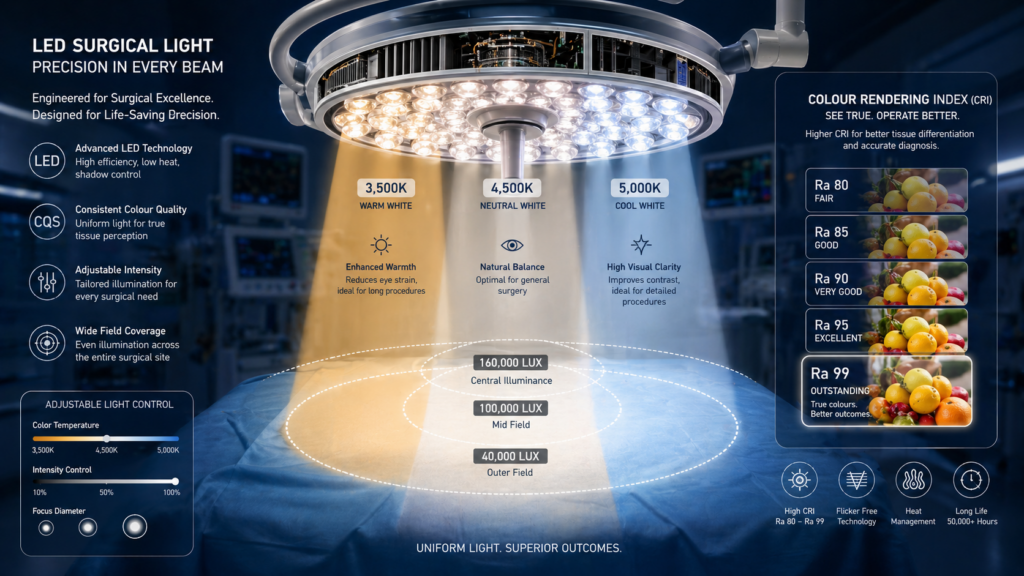
When hospital owners and clinic administrators evaluate surgical lights, three technical metrics appear on every specification sheet: lux, CRI, and color temperature. These numbers are not marketing language. They describe how much light reaches the surgical field, how accurately that light reveals tissue color, and whether the hue of that light supports or undermines a surgeon’s visual precision. Getting these three parameters wrong is not just a purchasing error. It is a clinical risk. A surgical light with poor color rendering can mask the subtle difference between healthy and compromised tissue. One that is too dim reduces a surgeon’s ability to work precisely in deep cavities. One with an inappropriate color temperature will cause progressive eye fatigue during long procedures. This guide explains all three metrics in plain technical language so hospital decision-makers can evaluate specifications confidently, compare products fairly, and make purchases that serve clinical teams over the long term. What Is Lux in Surgical Lighting? Lux is the unit of illuminance. It measures how much visible light falls on a surface per unit area. In surgical lighting, lux tells you how bright the field of view is at the operating site. In operating theatre specifications, two lux values matter most: IEC 60601-2-41 — the international standard governing surgical luminaires — sets the minimum central illuminance at 40,000 lux, with the maximum ceiling at 160,000 lux. High-performance LED surgical lights routinely deliver central illuminance values at the upper end of this range, providing surgeons with an intensely lit, clearly defined operating field. However, raw lux alone does not tell the full story. A fixture could deliver 100,000 lux of poorly coloured light and still make it harder to read tissue accurately. That is where CRI comes in. What Is CRI and Why Does It Matter in Surgery? The Color Rendering Index (CRI) measures a light source’s ability to accurately reproduce the natural colours of the objects it illuminates, compared to a reference light source. It is expressed as an Ra value, ranging from 0 to 100. In everyday commercial spaces, an Ra of 80 is generally considered acceptable. In surgery, that threshold is far too low. Surgeons must be able to distinguish subtle differences in tissue shade, identify vascular structures, spot signs of necrosis or bleeding, and navigate anatomical planes that differ in colour by just a few shades. For clinical and surgical settings, an Ra of 90 or above is the accepted minimum. Diagnosis, laboratory, surgical, and treatment areas should all be lit to CRI 90+, while non-clinical and non-surgical spaces may operate at CRI 80+. High-end surgical lights regularly exceed Ra 95, and some specialist units achieve Ra 99, providing near-perfect colour fidelity across the entire surgical field. Ra vs. R9 — The Full Picture of Color Rendering Ra is an average of how well a light source renders a set of standard test colours. However, a high Ra alone does not guarantee that a light renders red tones accurately — and red accuracy matters enormously in surgery because blood, vascular tissue, and organs are predominantly red. The R9 value is the individual rendering score for saturated red. A surgical light can have a strong Ra score but a weak R9, which means it will still distort how blood and tissue appear. When evaluating surgical light specifications, always check both Ra and R9 together. Clinical lighting references state that all luminaires in a single area should have the same CRI values to avoid inconsistency across the field. What Is Color Temperature in Surgical Lights? Color temperature, expressed in Kelvin (K), describes the hue or visual tone of the light a fixture emits. Lower Kelvin values produce warmer, more yellowish light. Higher values produce cooler, more daylight-like light with a bluish tint. Surgical lights are specifically engineered to operate in the colour-neutral range between 3,000K and 6,700K. This band provides illumination that supports accurate tissue identification and clinical visibility without tilting too warm or too cool. Within that range, different temperature settings serve different clinical needs: Color Temperature Visual Character Best Clinical Use 3,500 K – 3,800 K Warm, slightly amber Long general surgeries, reduced visual fatigue, reddish tissue procedures 4,000 K – 4,500 K Neutral white Balanced all-purpose OR lighting, most common general setting 4,500 K – 5,000 K Cool, daylight-like Fine tissue differentiation, vascular surgery, plastic surgery Above 6,000 K Cold, blue-tinted Too harsh for most clinical applications; avoid at high lux levels Warm vs. Cool: Which Is Right for Your OR? There is no single definitive answer backed by strong scientific consensus. Current guidance indicates that color temperatures around 3,800K give a more yellowish, peaceful light that works well for reddish tissues, while temperatures around 4,500K provide whiter, cooler tones. Both reliably support tissue colour restitution, and the practical choice often depends on surgical specialty, surgeon preference, and procedure duration. The most clinically flexible approach is to specify surgical lights with adjustable color temperature — typically spanning 3,500K to 5,000K — so the team can optimise the setting for each procedure. How Lux, CRI, and Color Temperature Work Together These three metrics are interdependent. A surgical light is only as clinically effective as its weakest parameter. Consider the following scenario: A hospital installs a fixture with excellent central illuminance — 120,000 lux — but the CRI is 82 and color temperature is fixed at 6,500K. The surgical field will be extremely bright, but surgeons will struggle to distinguish tissue colours accurately. The cool, harsh light may also accelerate eye fatigue during long procedures. Conversely, a fixture with CRI 97 and ideal color temperature but inadequate lux output cannot illuminate deep surgical cavities effectively. A perfectly rendered image of tissue that the surgeon cannot see clearly is no help. The clinical benchmark that best surgical lights try to achieve is: IEC 60601-2-41: The Standard That Governs These Metrics IEC 60601-2-41 is the primary international standard for surgical luminaires. It defines performance requirements including minimum and maximum central illuminance, illuminance uniformity ratios, colour rendering, and radiant
Emergency Department Lighting: Special Considerations & Requirements
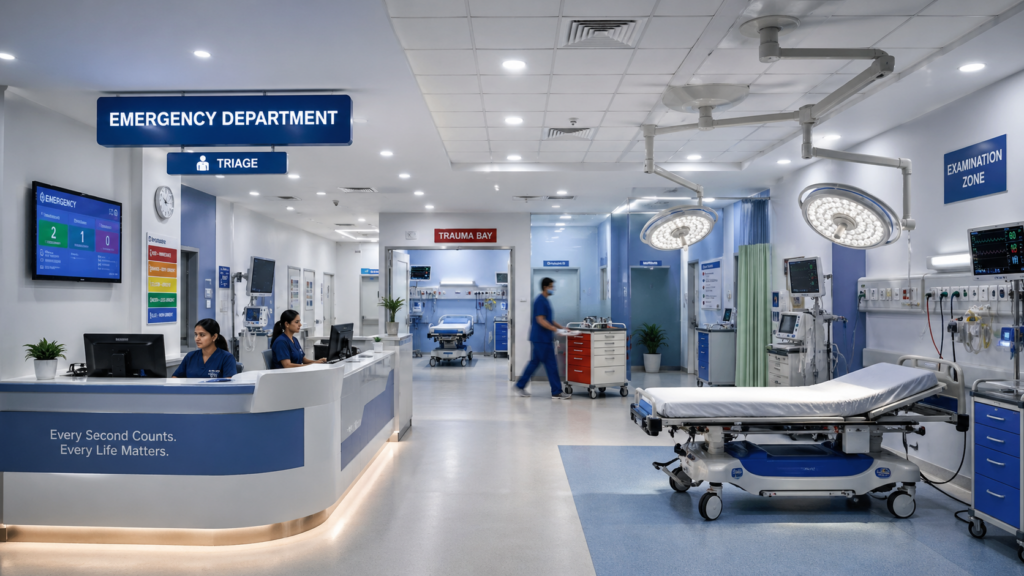
Emergency department lighting is not just about making a room bright. It has to support triage, rapid examination, trauma response, minor procedures, staff circulation, and safe egress when normal power fails. That is why emergency room lighting should never be specified like a standard commercial interior. In healthcare facilities, emergency egress lighting is served by the life safety branch, while other lighting that must stay operative for patient care can be served by the critical branch of the essential electrical system. For hospital owners and clinic operators in India, this topic is especially important because published research has noted that NABH and JCI accreditation do not themselves provide detailed lighting values for hospital spaces, so teams often need to align accreditation planning with broader lighting standards and equipment requirements. This guide explains where general ambient lighting is enough, where ER surgical lights or procedure lights are needed, and what to prioritise for compliance, visibility, comfort, and long-term operating cost. Why ED lighting is different Emergency departments handle many visual tasks in the same footprint. Examination areas need bright, consistent light that reveals clinical signs clearly, while trauma bays benefit from shadow-free illumination similar to operating-room conditions. At the same time, the department should not feel visually chaotic. Good hospital lighting design also improves wayfinding, reduces confusion, and helps create a calmer environment in waiting and circulation areas. The most effective approach is layered lighting. That means treating triage, exam bays, trauma/procedure zones, nurse stations, corridors, and emergency egress as separate lighting tasks rather than forcing one fixture type to do everything. Lighting layers to specify Zone What the lighting must do What to specify Triage and exam bays Support fast assessment with bright, even illumination and reliable colour perception. Use uniform ambient lighting plus dedicated examination lights; in colour-critical spaces, 90+ CRI is a sensible starting point. Trauma and resuscitation bays Reduce shadows during invasive care and rapid intervention. Use dedicated procedure or surgical luminaires; IEC-based surgical luminaires are typically specified in the 40,000 to 160,000 lux range at the field. Corridors and exits Keep staff and occupants moving safely during power loss. NFPA-based references call for average emergency illumination of 1 foot-candle, or 10.8 lux, with a 0.1 foot-candle, or 1.1 lux, minimum along the egress path for 90 minutes. High-risk task points Allow safe action where visibility is critical during an incident. EN-based guidance commonly uses 15 lux minimum for high-risk task areas. Waiting and observation areas Maintain visibility without increasing stress or glare. Add layered ambient light, glare control, and separate scenes for day, evening, and night use. Technical requirements Colour rendering matters more in an emergency department than in most commercial spaces. General indoor projects often accept 80 CRI as a baseline, but where accurate colour appearance matters, 90 CRI and above is the better starting point. That matters in real clinical work because staff are looking at skin tone, blood, bruising, wounds, and subtle tissue changes. Neutral white light with high colour fidelity generally makes those assessments easier than warm, low-CRI light. Shadow control is another major requirement. Emergency department guidance notes that trauma bays should have shadow-free illumination similar to operating rooms, and recessed ambient fixtures can help reduce unwanted side-shadowing compared with suspended fixtures. Heat at the working field also deserves attention. Modern surgical lights increasingly use LED because they consume less energy, generate less heat, and provide clearer illumination than older halogen systems, which were associated with greater eye fatigue and risk of tissue desiccation. Emergency power performance should be specified upfront, not added later. In healthcare occupancies, the essential electrical system separates life safety and critical functions, and emergency illumination references commonly require at least 90 minutes of operation during failure of normal lighting. Testing duration can vary by jurisdiction. For example, UK healthcare guidance commonly points to 3-hour emergency lighting duration in many installations, while NFPA-based references centre on 90 minutes, so final design should always be checked against local fire, electrical, and hospital requirements. Compliance and design strategy One of the biggest planning mistakes is assuming accreditation alone answers the lighting brief. Indian hospital research found that NABH and JCI do not provide specific lighting requirements, which helps explain why many hospitals still show poor compliance with prescribed lighting standards in practice. For that reason, emergency department owners should combine accreditation planning with technical references. Useful external benchmarks include the NABH hospital standards, IEC guidance for surgical and examination luminaires, and clinical environment references such as WHO safe surgery guidance. Energy use should also be part of the specification discussion. Hospitals run lighting for long hours, and LED-based clinical lighting is increasingly preferred because it lowers heat and operating load compared with halogen-based alternatives. A practical emergency department spec usually works best when it follows five rules: How to choose ER surgical lights Not every emergency room bay needs a surgical light. General examination cubicles usually need bright ambient light and a focused exam light, while trauma bays, resuscitation spaces, and procedure-capable rooms justify shadow-free procedure or surgical luminaires. If your hospital is comparing LED options, start with fixture purpose rather than headline lux alone. A triage bay, a suturing room, and a resuscitation bay may all need different beam patterns, mounting methods, and backup-power strategies even when they sit in the same department. For internal research, Hospilights can support this topic with contextual pages such as Energy-Efficient Surgical Lights for Operation Theatres, the Hospi Exhibition Hyderabad Booth M7 LED Surgical Lights page, and the main Hospilights website. A useful buying checklist for emergency room lighting should include: Frequently Asked Questions What lux level should an emergency department have? There is no single lux target that works for every part of an emergency department. Egress lighting references commonly call for an average of 10.8 lux and a minimum of 1.1 lux along the floor-level path of egress for 90 minutes, while procedure-capable surgical luminaires are commonly specified in the 40,000 to 160,000 lux range at the field. Do all ER bays need surgical lights? No.
Hospi Light India at HOSPI Exhibition Hyderabad 2026 | Visit Us at Booth M7 for Premium LED Surgical Lights
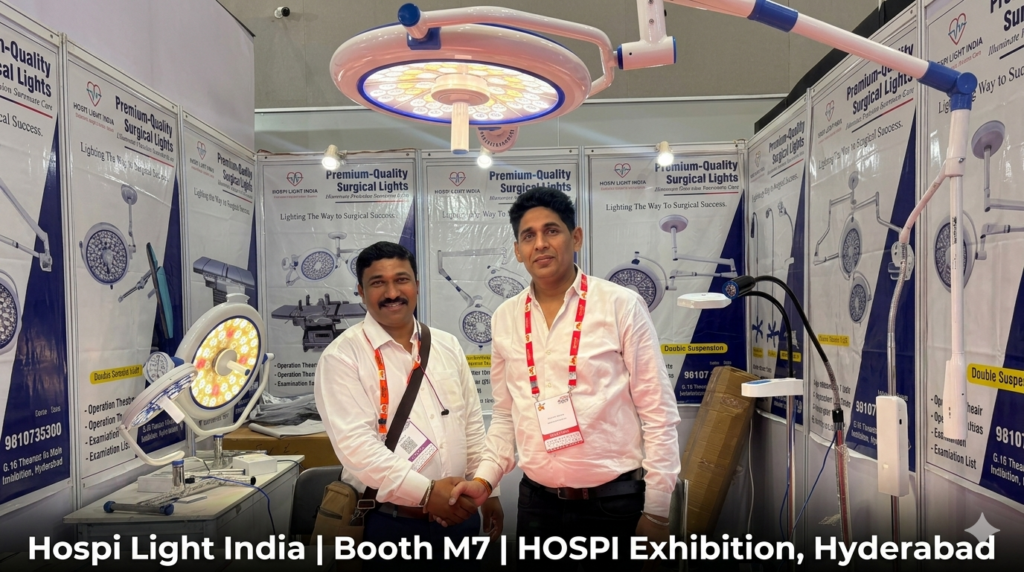
India’s operation theatres are evolving faster than ever. With hospitals in Hyderabad, Bengaluru, and across South India investing in modular OTs and next-generation surgical suites, the demand for precision-grade LED surgical lighting has never been more acute. Inadequate illumination during surgery is not simply an inconvenience — it is a clinical risk. Shadow formation, colour distortion, and thermal heat from outdated halogen systems continue to compromise surgical outcomes in facilities that haven’t yet made the switch. Hospi Light India, one of India’s earliest and most trusted surgical lights manufacturers since 1995, is bringing its full portfolio of advanced LED OT lights and examination lights to Booth M7 at the HOSPI Exhibition, Hi-Tech Exhibition Centre, Hyderabad. With ISO 13485 certification, over 500 hospital installations nationwide, and a proud Made in India heritage, we are ready to demonstrate how the right light changes everything inside an operation theatre. Whether you are a hospital administrator planning a new OT setup, a biomedical procurement head evaluating suppliers, or a clinician looking for examination lights for a new wing — this is the exhibition stop you cannot afford to miss. In this article, you will discover: Table of Contents About the HOSPI Exhibition at Hi-Tech Exhibition Centre, Hyderabad The HOSPI exhibition is one of South India’s premier gatherings for healthcare equipment professionals, hospital infrastructure planners, and clinical procurement teams. Hosted at the Hi-Tech Exhibition Centre in Hyderabad, the event brings together manufacturers, distributors, and healthcare decision-makers under one roof — making it the ideal venue to evaluate, compare, and source surgical-grade medical equipment. Hyderabad has emerged as a healthcare powerhouse, home to major multi-specialty hospital chains, NABH-accredited surgical centres, and a rapidly expanding network of private clinics and day-care surgery facilities. For surgical equipment manufacturers, it represents one of the most dynamic procurement markets in India today. What Hospi Light India Is Showcasing at Booth M7 Find us at Booth M7 — and you will find India’s most comprehensive range of LED OT lighting solutions on live display. Our team will be present throughout the exhibition for demonstrations, technical consultations, and on-the-spot quotations. Here is what we are bringing to Hyderabad: LED OT Surgical Ceiling Lights Our flagship ceiling-mounted surgical lights — including the Hospi Pari’s 80+80, Hospi Star 48+48 HD (delivering up to 160,000 lux), and the 54+54 LED OT Light — are engineered for shadow-free, high-colour-rendering illumination. Explore the full OT surgical lights range at hospilights.com for detailed specifications. Examination Lights The Examination Light E-7 and Hospi E-1 Vision provide brilliant, focused illumination for bedside examinations, minor procedures, and outpatient consultations. Lightweight, adjustable, and low-heat — they are purpose-built for clinical versatility. Wall-Mounted & Mobile Procedure Lamps For facilities where ceiling mounting isn’t viable, our Wall Mounted Surgical Light and Mobile Procedure Lamp deliver the same high-performance LED technology in a flexible installation format. Ideal for smaller clinics, day-care surgery setups, and ICU side rooms. Camera-Integrated Surgical Light Our Camera Integrated OT Light is designed for surgical documentation, medical education, and laparoscopic-assist environments — combining 4K-compatible camera mounting with surgical-grade illumination. If you are in the process of setting up a new operation theatre, our Complete OT Setup Checklist is a valuable pre-visit resource. Why LED Technology Has Become the Surgical Standard The shift from halogen to LED in operation theatres is no longer a trend — it is an evidence-backed clinical imperative. The World Health Organization’s guidelines on safe surgery emphasise consistent, adequate illumination as a prerequisite for surgical safety. LED technology delivers on this in ways halogen never could. Key clinical advantages of LED surgical lights: For a detailed comparison, read our article on LED vs Halogen Surgical Lights to understand exactly why our Hyderabad hospital partners made the switch. High-Lux Examination Lights: The Unsung Heroes of Patient Care While OT lights get most of the attention, examination lights are the workhorses of a hospital’s daily clinical activity. From gynaecology OPDs and ENT clinics to ICU bedsides and emergency procedures, a high-quality examination light improves both speed and accuracy of assessment. Hospi Light India’s examination lights are designed for: Procurement teams attending the HOSPI exhibition can review our surgical lights price guide for India (2026) before arriving at Booth M7 for a more focused conversation. Applications Across Specialties — OT, ICU, Gynaecology & More Our LED surgical lights are in active use across a broad spectrum of clinical environments. Here is how different specialties benefit: General Surgery & Orthopaedics High-lux ceiling-mounted OT lights with deep focus capability — ideal for abdominal, orthopaedic, and vascular procedures requiring prolonged, shadow-free illumination. Gynaecology & Obstetrics Examination lights with flexible, focusable arms are standard equipment in gynaecology OPDs and labour rooms. The Hospi E-1 Vision is especially popular in this setting. ICU & Critical Care Mobile procedure lamps and wall-mounted examination lights allow bedside procedures — line insertions, wound inspections, and emergency interventions — without disturbing adjacent patients. Paediatrics & NICU Soft, adjustable LED examination lights used alongside our NICU equipment range provide safe illumination for neonatal assessments and minor procedures. Dermatology & Minor OT The Eco Light Doom 35+35 and single-dome ceiling lights are cost-effective solutions for dermatology and minor surgical setups that require good illumination without the footprint of a full OT system. If you are unsure which product is right for your facility, our OT Lights Buying Guide outlines the ten critical factors to evaluate before purchase. Energy Efficiency That Pays for Itself Hospitals are high-energy-consumption environments. Operation theatres, running 8–16 hours per day, contribute significantly to electricity costs. Hospi Light India’s LED surgical lights consume up to 70% less power than comparable halogen systems — without any compromise in lux output. Additionally, LED lamps in our OT lights have a rated operational life exceeding 50,000 hours, drastically reducing lamp replacement costs and unplanned maintenance downtime. For multi-OT facilities running multiple theatres simultaneously, the return on investment from switching to LED can be realised within the first year of operation. The CDSCO (Central Drugs Standard Control Organisation) in India continues to
Energy Efficient Surgical Light for Operation Theatre: A Strategic Guide for Hospitals
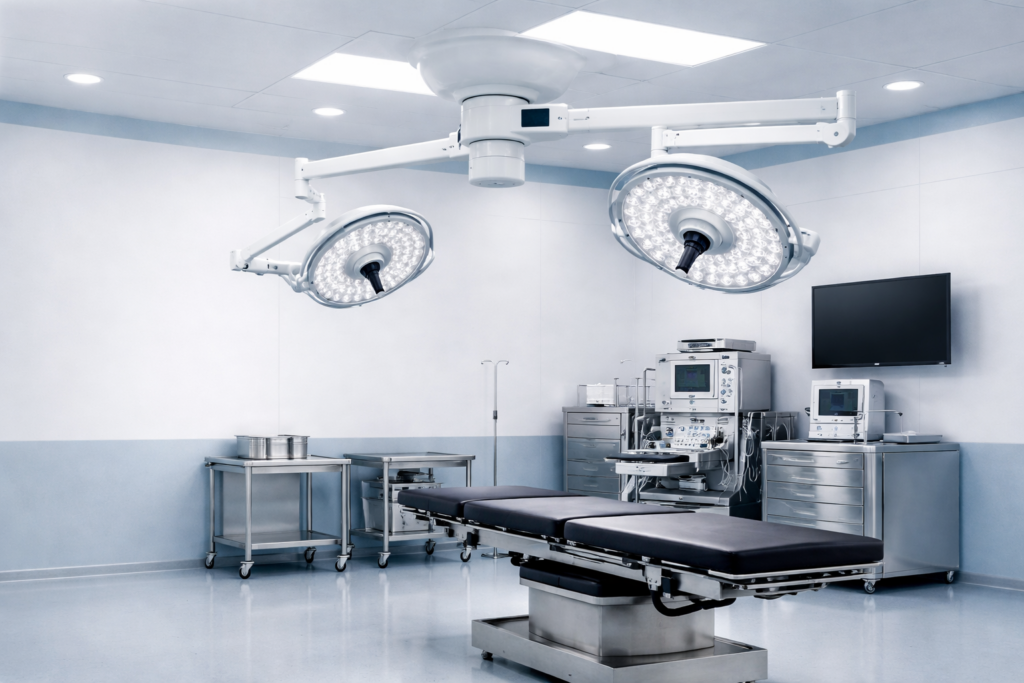
Energy-Efficient Surgical Lights for Operation Theatres: The Complete Hospital Buyer’s Guide Operating theatres demand precision at every level — and lighting sits at the very core of surgical safety. Yet across hundreds of hospitals and medical institutions in India, lighting remains one of the most overlooked aspects of OT infrastructure planning. Decision-makers focus on surgical tables, anaesthesia equipment, and sterile environments, often treating overhead illumination as an afterthought. The reality is sharply different. Surgical lighting directly influences a surgeon’s visual acuity, fatigue levels, and the clinical team’s ability to distinguish tissue types under sustained, high-pressure conditions. And as energy costs continue to rise — and sustainability benchmarks become mandatory for NABH accreditation — the shift toward energy-efficient surgical lights for operation theatres is no longer optional. It is strategically sound. At Hospilights, we manufacture and supply surgical lights, OT lights, and OT tables to hospitals, medical colleges, and specialty clinics across India. This guide consolidates everything procurement decision-makers need to know before investing in modern, energy-efficient OT lighting. Table of Contents 1. Why Energy Efficiency in OT Lighting Matters Operation theatres are among the most energy-intensive spaces in any hospital. HVAC, sterilisation systems, medical imaging, and continuous lighting run simultaneously — often 24 hours a day in multi-specialty facilities. Surgical lights alone can account for a disproportionate share of a department’s electricity load when conventional halogen or incandescent systems are used. Beyond the electricity bill, the clinical case for energy-efficient lighting is equally compelling. Older lighting technologies emit significant heat — raising the ambient temperature at the surgical field, creating discomfort for surgeons during long procedures, and increasing the risk of tissue desiccation in open-cavity surgeries. Modern energy-efficient systems, particularly LED-based surgical lights, deliver equivalent or superior lux output at a fraction of the thermal emission and power draw. From a policy standpoint, India’s Bureau of Energy Efficiency (BEE) under the Ministry of Power has progressively mandated energy standards across commercial and institutional buildings. Hospitals seeking NABH accreditation or green building ratings benefit directly from upgrading to certified, low-energy lighting systems. 2. LED vs. Halogen: A Direct Comparison The market has shifted decisively toward LED-based surgical illumination. Understanding why requires a direct, specification-level comparison. Parameter LED Surgical Light Halogen Surgical Light Power Consumption 30–80 W 150–300 W Lux Output 80,000–160,000 lux 60,000–120,000 lux Colour Rendering Index (CRI) 95–98+ 85–92 Colour Temperature 3,500–5,000 K (adjustable) Fixed ~3,200 K Heat at Surgical Field Very low High Lifespan 50,000+ hours 1,000–2,000 hours Maintenance Cost Minimal Frequent bulb replacement Shadow Management Multi-source array (shadowless) Limited LED surgical lights not only consume 60–75% less power than halogen equivalents — they produce measurably better clinical conditions. The higher CRI ensures surgeons can accurately differentiate blood, tissue, and organ structures. Adjustable colour temperature settings allow teams to optimise lighting for different procedure types, from general surgery to microsurgery. For facilities evaluating procurement costs comprehensively, our detailed breakdown of surgical lights price in India covers current market ranges across LED segments and configurations. 3. Core Technical Specifications to Evaluate When assessing energy-efficient surgical lights for an operation theatre, procurement teams should evaluate the following parameters against their facility’s clinical requirements: Illuminance (Lux): The International Electrotechnical Commission (IEC) standard 60601-2-41 specifies a minimum of 40,000 lux for surgical lighting, with major procedures requiring 80,000–160,000 lux. Ensure the light you select meets this range under real-world conditions, not just peak-rated output. Colour Rendering Index (CRI): A CRI of 95 or above is the clinical benchmark for surgical environments. Lower CRI values compromise tissue colour differentiation — a genuine safety concern during vascular or oncological procedures. Colour Temperature (CCT): Adjustable CCT between 3,500 K and 5,000 K accommodates diverse procedure types. Warmer tones reduce eye fatigue during extended procedures; cooler tones increase contrast and detail visibility. Shadow Dilution: Modern LED surgical lights use multi-LED array configurations to eliminate hard shadows from instruments and hands in the surgical field. Evaluate the depth-of-illumination range and shadow dilution rating. Heat Emission at Field (Irradiance): Measured in mW/cm², this value should conform to IEC 60601-2-41 limits. Low-irradiance LED systems protect tissue integrity during prolonged procedures. IP Rating and Sterility Compliance: OT lights must carry appropriate IP (Ingress Protection) ratings for cleanroom environments and support efficient surface sterilisation protocols. Before finalising specifications, we recommend reviewing our comprehensive OT lights buying guide for a detailed specification checklist tailored to Indian healthcare procurement standards. 4. Regulatory Compliance and Accreditation Alignment Hospitals seeking NABH (National Accreditation Board for Hospitals & Healthcare Providers) accreditation must demonstrate that their OT infrastructure meets defined safety, hygiene, and equipment standards. Surgical lighting is explicitly referenced in facility assessment criteria. Key compliance considerations include: University medical institutions and teaching hospitals face an additional compliance layer — their OT facilities are often evaluated by Medical Council of India (MCI/NMC) inspectors. Modern, well-documented LED surgical lighting systems support audit readiness and demonstrate institutional investment in clinical infrastructure. 5. ROI and Long-Term Cost Savings for Hospitals The total cost of ownership (TCO) for surgical lighting goes well beyond the purchase price. Facilities that evaluate only the upfront cost of halogen systems systematically underestimate ongoing operational expenditure. A 300 W halogen surgical light running 10 hours per day generates approximately 1,095 kWh per year per unit. At India’s average commercial electricity rate of ₹8–10 per unit, that represents ₹8,760–₹10,950 per light annually — before accounting for bulb replacements (every 1,000–2,000 hours) and maintenance labour. A comparable 80 W LED surgical light under the same usage generates approximately 292 kWh per year — delivering energy savings of over 70% per unit. With a lifespan exceeding 50,000 hours and near-zero replacement costs, the payback period for the higher upfront LED investment is typically 18–36 months for a mid-sized hospital. For multi-theatre hospitals or medical colleges running four or more active OT suites, the cumulative savings across a five-year cycle routinely exceed ₹15–25 lakh, depending on facility size and usage patterns. Smaller facilities and specialty clinics should not assume LED surgical lighting is out of reach. Our guide to quality
ICU Equipment Suppliers in Delhi: What Every Hospital Purchase Manager Must Know Before Buying
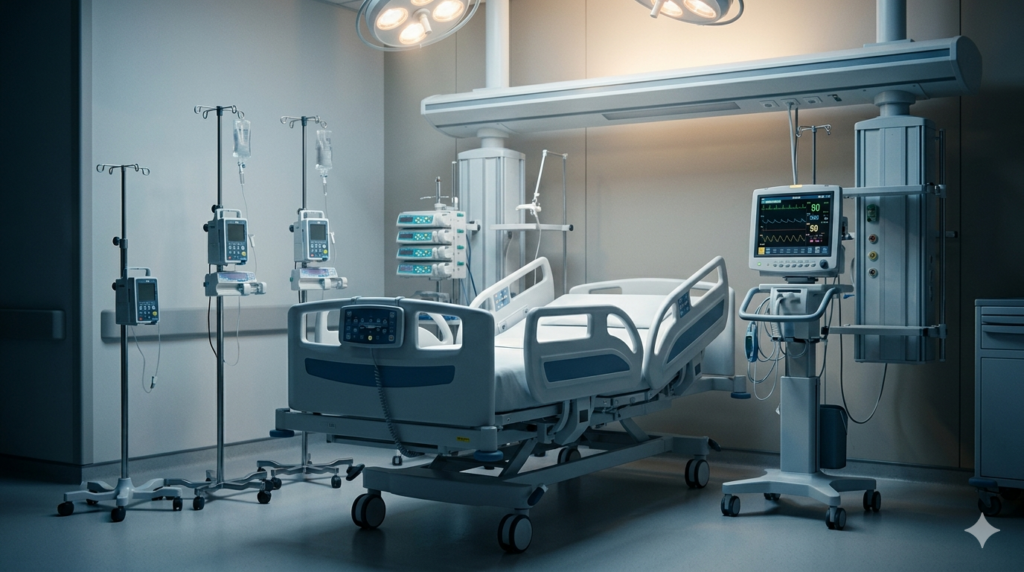
Equipping an Intensive Care Unit is one of the most consequential purchasing decisions a hospital makes. The wrong equipment — poorly specified, non-compliant, or backed by an unreliable supplier — does not just drain the procurement budget. It puts patients at risk. For hospital administrators and biomedical engineers across Delhi NCR, the challenge is rarely a shortage of suppliers. It is the challenge of telling them apart. With dozens of vendors operating across Karol Bagh, Bawana, and Okhla Industrial Area, and many more listing on B2B portals without physical presence, knowing which ICU equipment suppliers in Delhi are genuinely trustworthy takes more than a Google search. At Hospi Lights, we have been manufacturing critical healthcare equipment from our Delhi facility since 1995 — serving multi-speciality hospitals, nursing homes, and government medical institutions across India. This guide draws on nearly three decades of that experience to help procurement teams make sharper, safer decisions. What Qualifies as ICU Equipment? A Procurement Checklist Before approaching any supplier, your biomedical engineering team should align on the full scope of ICU equipment. A modern critical care unit typically requires: Patient Monitoring & Life Support ICU Furniture & Infrastructure Specialised Critical Care Units Surgical Support Adjacent to ICU Understanding this scope matters because the best ICU equipment suppliers in Delhi rarely supply only one category. A partner who covers multiple equipment lines reduces coordination overhead and gives you a single point of accountability for after-sales service. 5 Critical Factors When Evaluating ICU Equipment Suppliers in Delhi 1. Regulatory Compliance — Non-Negotiable All medical devices sold in India must meet the standards set by the Central Drugs Standard Control Organisation (CDSCO), India’s national regulatory authority under the Ministry of Health & Family Welfare. Under the Medical Devices Rules, 2017, ICU equipment falls across risk Classes B, C, and D — meaning higher regulatory scrutiny applies. Before finalising any supplier, your purchase team should verify: A supplier who hesitates to share compliance documentation is a supplier to move on from. 2. Manufacturing Origin vs. Trading House Delhi NCR has a large population of traders who import equipment from China or South-East Asia and resell it under Indian labels. There is nothing illegal about this — but as a buyer, you need to understand what you are getting. A Delhi-based manufacturer gives you: When evaluating suppliers, ask directly: Do you manufacture these products, or do you source them? Request a factory visit if the order value justifies it. Hospilights manufactures OT lights, hospital ICU beds, and critical care furniture from our Bawana Industrial Area facility in Delhi — and welcomes on-site visits from procurement teams. 3. After-Sales Service Coverage in Delhi NCR ICU equipment failure at 2 AM is not a hypothetical. It happens. Your supplier’s service infrastructure must match the geography of your hospital. Questions to ask every vendor before signing: A supplier without a local service team in Delhi is a risk to your uptime and — ultimately — to patient outcomes. 4. Installation Support and Biomedical Staff Training High-specification ICU equipment is only as effective as the staff operating it. Reputable ICU equipment suppliers in Delhi should offer: This is particularly important for NICU equipment such as phototherapy units and infant warmers, where misuse carries immediate clinical risk. 5. Warranty Terms and Total Cost of Ownership The purchase price is rarely the true cost. Before comparing quotes, ask each supplier to provide: A lower sticker price with costly AMCs and imported consumables often exceeds the total cost of a locally manufactured alternative over a five-year horizon. Why Delhi-Based Manufacturers Have a Structural Advantage For hospitals in the NCR — whether in South Delhi, Noida, Gurugram, Faridabad, or Ghaziabad — sourcing from a manufacturer based in Delhi provides measurable operational advantages: Hospilights has served hospitals across Delhi NCR for nearly three decades, with over 500 installations across multi-speciality hospitals, nursing homes, and critical care centres — a track record that matters when you need a supplier who will still be there for your next procurement cycle. Red Flags to Watch for When Shortlisting ICU Equipment Vendors In a market as active as Delhi’s medical equipment supply sector, some red flags are easy to overlook under procurement timeline pressure: Frequently Asked Questions What ICU equipment do hospitals in Delhi most commonly procure from local suppliers? The highest-volume categories among Delhi NCR hospitals include ICU beds with motorised controls, multi-parameter patient monitors, infusion pumps, and ventilators. Furniture items such as hospital beds, overbed tables, and OT chairs are also frequently sourced locally because of the logistics advantage. Is CDSCO certification mandatory for all ICU equipment purchased in India? Yes. Under the Medical Devices Rules, 2017, all notified medical devices — which include most ICU equipment categories — must be registered with CDSCO before they can be legally sold or imported in India. Buyers should request proof of CDSCO registration for every device in their purchase order. Can I source ICU equipment and OT equipment from the same Delhi supplier? Absolutely, and it is often advisable. Suppliers who cover both ICU and adjacent surgical infrastructure — such as OT surgical lights — can offer better bundled pricing, unified service contracts, and streamlined installation coordination. How do I verify that an ICU equipment supplier in Delhi is a genuine manufacturer? Request the supplier’s manufacturing licence (issued by the State Drug Controller or CDSCO), ask for a factory visit, and check their CDSCO registration on the official CDSCO Sugam portal. Genuine manufacturers will have verifiable addresses and publicly traceable compliance records. What is a reasonable warranty period for ICU beds and hospital furniture from Indian manufacturers? Industry standard is one to two years for comprehensive warranty on ICU beds and hospital furniture. Leading manufacturers often offer extended AMC options. Always clarify whether warranty covers parts, labour, and on-site service — or only parts. Key Takeaways Ready to discuss your ICU or OT equipment requirements? The Hospilights team works directly with hospital purchase committees, biomedical departments, and facility administrators across Delhi NCR.
Surgical Lights for Small Clinics vs Large Hospitals: What’s the Difference?
Hospilights Blog OT Setup Surgical Lights: Clinics vs Hospitals Surgical Lights forSmall Clinics vs Large Hospitals:What’s the Difference? Scale, budget, lux requirements, shadow management, and what you actually need — a complete comparison for procurement decision-makers. Hospilights Editorial · 2025 10 min read · ~2,000 words OT Lighting · Clinic Setup · Budget Planning Walk into any operating room and the first thing you notice is the light. Bright, shadowless, precisely focused — the surgical light above the table is not just a fixture, it is a critical piece of clinical equipment. Yet one of the most common mistakes made during hospital and clinic setups is choosing lighting based purely on price, without understanding that surgical lights for clinics and lights for large hospitals are engineered for very different environments, procedures, and budgets. Whether you are a GP setting up a minor procedure room, a specialist clinic performing day surgeries, or a hospital administrator commissioning a full OT suite, the lighting specifications you need will vary significantly. This guide breaks down exactly where those differences lie — in lux output, shadow management, colour rendering, mounting systems, and total cost of ownership — so you can make the right call for your facility the first time. The most fundamental difference between surgical lights for clinics and lights installed in large hospital OTs comes down to the scale and complexity of procedures. A small clinic or nursing home is typically performing minor surgeries: wound debridement, excision of superficial lesions, minor orthopaedic procedures, vasectomies, or dental surgeries. These procedures happen in well-illuminated spaces but do not require the extreme lux intensities or deep cavity access that a cardiac surgery or neurosurgery suite demands. A single-dome LED light with 40,000 to 80,000 lux is entirely appropriate — and in most cases more than sufficient — for these settings. Overpowering a minor procedure room with a 160,000-lux double-dome light is not just unnecessary spending; it can cause thermal discomfort during longer procedures. Large hospitals, on the other hand, are routinely performing abdominal explorations, thoracic surgeries, joint replacements, and complex reconstructions where the surgeon must illuminate deep anatomical cavities. Here, small hospital OT lights of the clinic tier simply cannot deliver. The lux requirements jump sharply, shadow management becomes critical — shadows at depth can obscure structures millimetres apart — and the surgeon needs to reposition the light mid-procedure without breaking sterility. These requirements dictate an entirely different product tier. Related Complete OT Setup Checklist Choosing OT Lights by Speciality Lux output is often the first specification clinicians focus on, but it is only half the picture. The other half is colour rendering — how accurately the light reproduces the true colour of tissue. This is measured by the Colour Rendering Index (CRI). A light with high lux but low CRI can make it difficult to distinguish healthy from necrotic tissue, or to identify bleeding points quickly. For minor procedures in surgical lights for clinics, a CRI of 85 or above is acceptable — and most quality LED options in the budget segment now meet this easily. For major surgical theatres, the threshold rises to CRI 95 or above. This near-perfect colour accuracy is not a luxury in a cardiac or reconstructive setting; it is directly linked to surgical precision and patient outcomes. Colour temperature is the companion specification to CRI. Most surgical lights operate between 3,500 and 5,000 Kelvin. A warmer tone around 3,500K reduces fatigue during long procedures, while a cooler tone near 5,000K maximises tissue contrast. Good small hospital OT lights at mid-range price points now routinely include this adjustability — making it no longer a feature reserved for premium hospital-grade models. At a Glance — Surgical Light Specifications by Facility Type Feature Small Clinics / Minor OT Large Hospitals / Major OT Lux Output 40,000 – 80,000 lux 100,000 – 160,000+ lux Light Heads Single dome (1 head) Double dome (2+ heads) Colour Rendering (CRI) ≥ 85 acceptable ≥ 95 mandatory Shadow Management Basic shadowless design Multi-segment deep shadow control Camera Integration Not required HD / 4K port essential Mounting Ceiling or wall-arm Ceiling pendant / boom system Satellite Light Optional Recommended for cavity surgery Budget Range (INR) ₹60,000 – ₹2,50,000 ₹3,00,000 – ₹12,00,000+ Typical Warranty 2 – 3 years 5 years (with AMC) LED Lifespan 30,000 – 40,000 hours 50,000+ hours Shadow management is the area where the gap between clinic-grade and hospital-grade lights is most technically pronounced. All modern LED OT lights are designed to be shadowless — multiple LED segments are arranged so that each compensates for the shadow cast by the others. In a standard single-dome light suitable for surgical lights for clinics, this is achieved with a single cluster of segments. It performs well for superficial and moderately deep procedures but begins to struggle when the operative field is deep — inside an abdominal cavity or around the spine. Large hospital lights solve this with a double-dome configuration, where a primary dome and a satellite dome work together to illuminate from multiple angles simultaneously. Some premium models add a third satellite for extreme cavity depth — a feature unnecessary in most clinic environments but indispensable in a tertiary care OT. Related LED vs Halogen OT Lights OT Light Maintenance for Clinics One of the most common questions Hospilights receives from clinics and smaller facilities is: where can you save money on surgical lighting, and where absolutely cannot you? This is a fair question, because budget surgical lighting does not have to mean compromised patient safety — but it does require knowing which specifications are negotiable and which are not. The features you can sensibly save on in a smaller facility include camera integration ports (essential for teaching hospitals, unnecessary for a GP procedure room), heavy-duty ceiling boom systems (a ceiling mount or spring arm is sufficient), and satellite light configurations. These are genuine cost drivers and removing them from your specification for a minor OT is entirely justifiable. Good budget surgical lighting for clinics typically falls
Setting Up a New Operation Theatre: Complete Equipment Checklist
Setting Up a New Operation Theatre: Complete Equipment Checklist | Hospilights Hospilights OT Lights Turnkey Blog AMC Contact Hospilights› Blog› OT Setup Setting Up a NewOperation Theatre:Complete Equipment Checklist Everything you need to plan, equip, and commission a fully compliant operation theatre — from lighting to anaesthesia, with real cost estimates. By Hospilights Editorial Team 2025 12 min read ~2,800 words OT Setup · Hospital Infrastructure Setting up a new Operation Theatre is one of the most critical — and most complex — investments a hospital can make. Every equipment decision directly impacts patient outcomes. This guide covers every category you need, with checklists, cost estimates, and links to expert resources from Hospilights. Section 01 OT Layout & Infrastructure Basics Before any equipment enters the room, your OT must be built to specification. Even the best surgical table is ineffective in a poorly designed space. Minimum OT Room Dimensions (NABH Standards) General Surgery OT: Minimum 400 sq. ft (37 sq. m) Cardiac/Neurosurgery OT: Minimum 600 sq. ft (56 sq. m) Minor OT/Procedure Room: Minimum 200 sq. ft Ceiling Height: Minimum 3 metres (for ceiling-mounted lights and booms) Ventilation: Positive pressure with HEPA filtration (Class 100/ISO 5 for major OT) Infrastructure Checklist Laminar Airflow (LAF) System installed and validated Dedicated electrical supply with UPS backup (minimum 5 KVA per OT) Medical gas pipeline — Oxygen, N₂O, Medical Air, Vacuum Anaesthesia gas scavenging system (AGSS) Non-slip, anti-static flooring (epoxy or vinyl) Scrub sink area with elbow-operated taps outside OT Separate clean and dirty corridors Related Hospital Infrastructure Planning Guide HEPA Filtration & OT Air Quality Section 02 OT Lighting — The Most Critical Equipment Decision Operation Theatre lighting is arguably the single most important equipment category. Poor lighting causes eye strain, increases procedure time, and can contribute to surgical errors. This is an area where cutting costs is never appropriate. Types of OT Lights You Need Main Surgical Light (Ceiling-Mounted): LED, shadowless, minimum 160,000 lux intensity, CRI ≥ 95 Satellite/Auxiliary Light: For deep cavity illumination in thoracic, abdominal, or spinal procedures Examination Light: For pre/post-procedure examination in the OT Ambient OT Room Lighting: Dimmable LED panels, minimum 500 lux at floor level Emergency Backup Lighting: Battery-backed LEDs activating within 0.5 seconds of power failure OT Light Specifications Checklist LED technology (50,000+ hours vs 2,000 for halogen) Adjustable colour temperature: 3,500K–5,000K Shadowless design with ≥ 8 light heads Sterile handle for intra-operative repositioning Camera integration port for HD video documentation Ceiling pendant/boom mounting with integrated gas and electrical outlets 🔗 Hospilights Product Explore our full range of NABH-compliant LED Operation Theatre Lights at hospilights.com/ot-lights — single-dome, double-dome, and minor OT variants. All come with a 5-year warranty and on-site AMC options. Related Choosing the Right OT Light LED vs Halogen OT Lights Section 03 Surgical Tables & Positioning Equipment The operating table is the centrepiece of your OT. It must accommodate your surgical specialities, withstand heavy use, and provide precise positioning to reduce complications. Types of Surgical Tables General Surgery Table: Multi-section, electrically adjustable, carbon fibre top for intraoperative X-ray Orthopaedic Table: With traction and fracture attachments, lateral positioning supports Gynaecology/Obstetric Table: Lithotomy position capability, adjustable leg holders Neurosurgery Table: Extra-long, head attachment compatible, prone positioning support Cardiac Surgery Table: Radiolucent, flat profile, steep Trendelenburg (min. 35°) Key Specifications Checklist Weight capacity: Minimum 250 kg (bariatric tables: 400+ kg) Electrically operated height adjustment: 450mm–1050mm range Trendelenburg and reverse Trendelenburg: ±35° Lateral tilt: ±20° Carbon-fibre or radiolucent tabletop Battery backup — minimum 8 hours for power failure scenarios Anti-decubitus, easy-clean mattress surface Related Surgical Table Buying Guide OT Table vs ICU Bed Section 04 Anaesthesia Equipment Anaesthesia equipment requires the most rigorous selection process of any OT category. Equipment failure here is immediately life-threatening. Always purchase from authorised, service-certified vendors. Core Anaesthesia Workstation Anaesthesia Machine with built-in ventilator (Volume-Controlled, Pressure-Controlled, SIMV modes minimum) Integrated vaporisers: Sevoflurane, Isoflurane (add Desflurane for cardiac/neuro) Breathing circuits: reusable silicone or single-use disposable Soda lime CO₂ absorber canister Bag-mask ventilation unit (AMBU bag) as emergency backup Anaesthesia gas scavenging system (AGSS) connection Airway Management Equipment Video Laryngoscope (GlideScope or equivalent) — essential for difficult airways Flexible fibreoptic bronchoscope Laryngeal Mask Airways (LMA): sizes 1–5 Endotracheal tubes: various sizes (cuffed and uncuffed) Cricothyrotomy kit for emergency surgical airway ⚠️ Important Anaesthesia machines must be serviced by factory-trained engineers every 6 months under a Preventive Maintenance Contract (PMC). Confirm PMC availability in your city before finalising your vendor. Visit hospilights.com/amc for AMC options across India. Related Anaesthesia Machine Maintenance Top 5 Anaesthesia Mistakes Section 05 Patient Monitoring Systems Intraoperative monitoring is non-negotiable. Modern OTs require continuous, multi-parameter monitoring with integrated alarms and documentation capability. Intraoperative Monitoring Checklist Multi-parameter patient monitor (ECG, SpO₂, NIBP, EtCO₂, Temperature, IBP) Invasive Blood Pressure (IBP) monitoring for cardiac/major vascular cases Bispectral Index (BIS) monitor for depth of anaesthesia Defibrillator/AED — accessible within 30 seconds from any OT position Infusion pumps (syringe and volumetric) — minimum 4 per OT Blood warmer for high-volume transfusion cases Ceiling-mounted monitor arms for anaesthesiologist’s display HIS integration terminal and printer for intraoperative reports Related Choosing a Multi-Parameter Monitor Defibrillator Placement in OT Section 06 Surgical Instruments & Specialty Equipment Surgical instruments vary by speciality. Below is a general-purpose OT instrument set plus commonly required specialty additions. General Surgery Basic Set Scalpel handles (sizes 3, 4, 7) with blade dispenser Haemostatic clamps: Mosquito, Kelly, Rochester — set of 12 each Retractors: Langenbeck, Deaver, Balfour self-retaining Electrosurgical unit (ESU / diathermy machine) — monopolar and bipolar Suction machine (surgical grade, with aspirator tips) Mayo stand and instrument trolleys Laparoscopy / Minimally Invasive Surgery Set 30° and 0° rigid laparoscope (10mm) CO₂ insufflator with high-flow capability (35 L/min) Full HD or 4K laparoscopy camera system with monitor Laparoscopic instrument set: graspers, scissors, clip applier, dissector Vessel sealing device (LigaSure or equivalent) Laparoscopy tower with electrosurgery integration 🔗 Hospilights Product Browse complete laparoscopy setup packages at hospilights.com/laparoscopy-setup — bundled pricing for new hospitals, includes installation, training, and 1-year warranty. Related Setting Up a Laparoscopy
LED vs Halogen Surgical Lights – Which is Better for Your Hospital?
LED vs Halogen Surgical Lights – Which is Better for Your Hospital? Introduction : Get to know more About Led Vs Halogen Surgical Lights If you’re upgrading your hospital’s surgical lighting or setting up new operation theatres, you’ll face a fundamental choice: LED or halogen surgical lights? Just a decade ago, halogen was the standard technology in most operation theatres worldwide. Today, LED technology has revolutionized surgical lighting, and the majority of new installations now choose LED. However, halogen lights are still available and significantly cheaper upfront, making some hospitals question whether the LED premium is worth it. This comprehensive comparison examines both technologies across every critical dimension—performance, cost, lifespan, energy efficiency, heat output, and more. By the end, you’ll understand exactly why LED has become the preferred choice for modern hospitals, and in what limited scenarios halogen might still be considered. Technology Overview Halogen Surgical Lights: The Traditional Choice Halogen lights work by passing electric current through a tungsten filament surrounded by halogen gas. The filament heats to extremely high temperatures (around 3000°C), producing intense white light. How They Work: Tungsten filament glows when heated Halogen gas regenerates evaporated tungsten back onto filament Reflectors direct light toward surgical field Multiple bulbs provide required intensity History: Halogen surgical lights replaced older incandescent technology in the 1980s-90s and became the standard for operation theatres worldwide until LED technology matured in the 2010s. LED Surgical Lights: Modern Technology LED (Light Emitting Diode) surgical lights use semiconductor technology to produce light through electroluminescence—a completely different process than heating filaments. How They Work: Electricity passes through semiconductor material Electrons release energy as photons (light) Multiple LEDs (30-80+ per dome) arranged in arrays Each LED produces focused, directional light Advanced optics and reflectors optimize distribution Development: While LED technology has existed since the 1960s, high-intensity LEDs suitable for surgical applications only became viable in the mid-2000s. Rapid improvements in LED efficiency, color quality, and cost have made LED surgical lights the new standard. Head-to-Head Comparison 1. Illumination Quality and Intensity LED Surgical Lights: Lux Output: 80,000-160,000+ lux (single to twin dome) Light Distribution: Highly uniform across surgical field Adjustability: Precise intensity control (typically 10-100%) Focus Quality: Sharp, well-defined light field with adjustable diameter Consistency: Maintains constant output throughout lifespan Instant On: Full brightness immediately upon switching on Halogen Surgical Lights: Lux Output: 60,000-120,000 lux (single to twin dome) Light Distribution: Good but can have hot spots Adjustability: Limited intensity control (often just high/low) Focus Quality: Good but less precise than LED Consistency: Output degrades as bulbs age (loses 20-30% brightness) Warm-up Time: Requires 30-60 seconds to reach full brightness Winner: LED – Superior intensity, uniformity, adjustability, and consistency Impact on Surgery: Surgeons report better tissue visualization with LED More precise control of lighting conditions Consistent performance throughout surgery Better illumination in deep cavities 2. Color Rendering Index (CRI) and Color Temperature Color accuracy is critical for distinguishing between tissue types, blood vessels, and pathology. LED Surgical Lights: CRI: 90-98 (excellent color accuracy) Color Temperature: Stable 4000-4500K (neutral white) Color Consistency: Remains constant throughout LED lifespan Adjustability: Premium models offer adjustable color temperature Tissue Appearance: Natural, accurate colors Halogen Surgical Lights: CRI: 95-100 (excellent when new) Color Temperature: 3200-3400K (warm white/yellowish) Color Consistency: Shifts as bulb ages (becomes more yellow) Adjustability: Fixed color temperature Tissue Appearance: Warmer tones, may affect color judgment Winner: LED – Better color temperature for surgery with superior long-term consistency Clinical Significance: LED’s neutral white (4000-4500K) is preferred by surgeons for accurate tissue visualization Halogen’s warm tone (3200-3400K) can make tissue appear more yellow LED maintains color consistency; halogen shifts over time Studies show surgeons prefer LED color for precision work 3. Energy Consumption and Operating Costs This is where LED shows dramatic superiority. LED Surgical Lights: Power Consumption: 40-80W per dome Daily Energy (8 hours): 0.32-0.64 kWh Annual Energy Cost: ₹820-₹1,640 per light (@₹7/kWh) 10-Year Energy Cost: ₹8,200-₹16,400 Efficiency: 80-90% of energy converts to light Halogen Surgical Lights: Power Consumption: 150-300W per dome Daily Energy (8 hours): 1.2-2.4 kWh Annual Energy Cost: ₹3,066-₹6,132 per light (@₹7/kWh) 10-Year Energy Cost: ₹30,660-₹61,320 Efficiency: Only 10-15% of energy converts to light (rest is heat) Energy Savings with LED: ₹22,000-₹45,000 per light over 10 years Winner: LED – Uses 60-75% less energy Hospital-Wide Impact: A 200-bed hospital with 6 operation theatres: LED total cost (10 years): ₹98,400 Halogen total cost (10 years): ₹367,920 Annual savings with LED: ₹26,950 10-year savings: ₹2,69,500 Plus additional savings on air conditioning (less heat to remove). 4. Heat Output and Surgical Field Temperature Excessive heat from surgical lights is more than uncomfortable—it’s a patient safety issue. LED Surgical Lights: Heat Output: 30-50 mW/cm² at surgical field Surface Temperature: 40-50°C (warm but not hot) Heat Mechanism: Minimal infrared radiation Patient Impact: Negligible heat felt by patient Surgeon Comfort: Cool operating conditions Tissue Effect: No desiccation of surgical site Halogen Surgical Lights: Heat Output: 120-180 mW/cm² at surgical field Surface Temperature: 70-90°C (very hot, burn risk) Heat Mechanism: High infrared radiation (60-70% of energy) Patient Impact: Significant heat on exposed tissue Surgeon Comfort: Uncomfortable, causes perspiration Tissue Effect: Can cause tissue drying and thermal damage Winner: LED – 70-85% less heat output Clinical Impact: With Halogen: Surgeons report discomfort within 15-30 minutes, increased perspiration, need for frequent breaks With LED: Surgeons comfortable throughout long procedures Patient Safety: LED reduces risk of thermal burns during long surgeries Infection Control: Less surgeon perspiration = lower contamination risk Additional Benefit: Lower air conditioning costs Halogen lights add significant heat load to OT Requires more powerful AC systems LED lights reduce cooling requirements by 30-50% 5. Product Lifespan and Bulb Replacement LED Surgical Lights: LED Lifespan: 50,000-60,000 hours (L70 rating) Real-World Use: 8 hrs/day = 17+ years 12 hrs/day = 11+ years 16 hrs/day = 8+ years Replacement: Entire light system (not just bulbs) Degradation: Gradual dimming to 70% over lifespan Bulb Changes: None required for entire lifespan Maintenance: Minimal Halogen Surgical Lights: Bulb Lifespan: 500-2,000 hours Real-World Use: 8 hrs/day = 2-8 months per