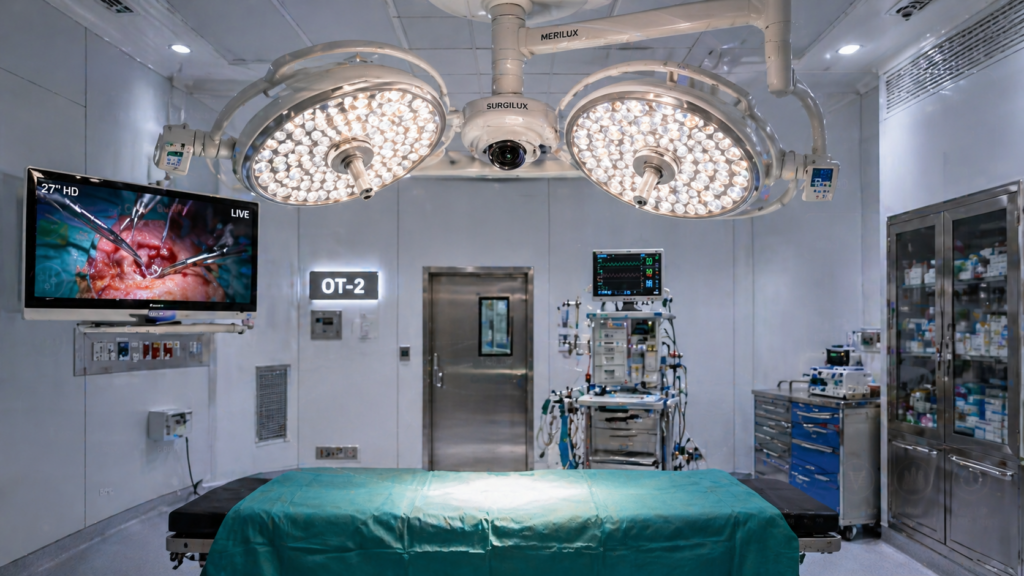
In the past decade, the definition of a surgical light has changed fundamentally. A light that only illuminates is no longer enough. Today’s leading operation theatre environments demand surgical lights with integrated cameras — systems that combine shadow-free illumination with real-time HD or 4K video capture, monitor connectivity, and remote documentation capability in a single ceiling-mounted unit.
For hospital owners and clinic administrators making procurement decisions right now, the question is not whether camera-integrated OT lights are a good idea. The question is whether you understand exactly what to specify, which features matter clinically, and which are marketing noise.
This guide answers all of that. It covers how surgical lights with integrated cameras work, what clinical problems they solve, which specifications to verify, and how Hospilights’ camera-ready surgical lighting solutions are designed for Indian hospital environments.
What Are Surgical Lights with Integrated Cameras?
A camera-integrated surgical light is an LED OT light that has a high-resolution camera built directly into the light head — positioned, ideally, at the optical centre of the light cone.
This positioning is critical. When the camera sits at the centre of the illumination field, it captures exactly what the surgeon sees, with the same brightness and colour fidelity that the light provides at the surgical site. Cameras mounted off-centre or added externally create viewing angle mismatches that reduce the clinical value of the footage.
The complete camera-integrated system typically includes three elements:
- The integrated camera: Mounted inside the light head; available in Full HD (1080p) or 4K resolution with optical zoom.
- The monitor: Connected via HDMI or IP output; can be mounted on a third arm, wall-mounted, or connected to a central OR display system.
- The control interface: Usually a touchscreen panel, light-head handle button, or wireless/remote control that keeps camera operation entirely outside the sterile field.
Hospilights’ camera-integrated surgical lights follow this architecture. The Hospi Star 48+48 HD and the HOSPI PARIS 80+80 are available with an optional HD camera and monitor, with HDMI/IP connectivity and remote control — making them directly compatible with modern OR documentation and teaching setups.
Why Hospitals Are Choosing OT Lights with Cameras
Camera-integrated surgical lights are not a luxury upgrade. They address four specific operational problems that hospitals face every day.
Clinical Documentation and Medico-Legal Protection
Every surgical procedure generates a medico-legal record. A camera system integrated into the surgical light captures real-time, high-resolution footage of the operative field from the optimal viewpoint — the same viewpoint the surgeon works from.
This documentation protects the hospital in the event of disputes, supports quality audits, and creates a verifiable record of surgical technique that standalone documentation methods cannot replicate.
Surgical Training and Medical Education
Teaching hospitals and medical colleges have used external cameras and endoscopic feeds for years, but these systems introduce viewing angle problems and setup complexity. A camera mounted in the light head provides a clean, overhead surgical field view that works for live observation on an in-room monitor, remote streaming to a seminar room, and recorded video libraries for curriculum use.
This is one of the primary reasons integrated camera surgical lights have moved from premium hospital segments into mid-tier and training institution procurement lists across India and globally.
Remote Consultation and Telemedicine
Surgeons consulting remotely — whether reviewing technique with a senior colleague, accessing a specialist opinion, or conducting a telemedicine-supported procedure — benefit directly from a stable, high-quality video feed of the operative field.
Wireless camera systems in surgical lights remove the need for additional camera infrastructure, reducing OR clutter and infection control complexity.
Multidisciplinary OR Team Coordination
In complex cases, anaesthesiologists, scrub nurses, and assistants who are not directly at the table benefit from a shared monitor view of the operative field. This improves team coordination, reduces the need for verbal communication, and helps non-scrubbed team members anticipate the next step.
Specifications That Actually Matter
Not all camera-integrated surgical lights are equal. Before purchase, verify these parameters against the data sheet.
One purchasing mistake to avoid: accepting camera resolution claims without confirming the resolution at the actual zoom range the camera will be used at. A system quoted at 4K may only maintain that resolution at base zoom and drop significantly when optical zoom is engaged.
Clinical Applications by Department
Camera-integrated surgical lights serve different purposes depending on where they are installed.
General surgery operation theatres benefit from documentation, team coordination, and the option to stream to a viewing gallery or remote consultant. This is the broadest and most common use case, and it justifies camera integration in virtually all general surgery OT builds.
Emergency department procedure rooms that handle trauma, emergency surgeries, or complex interventions benefit from the same documentation value as an OT, with the added benefit that critical care footage can be reviewed in real time by clinical teams outside the room. If your emergency department already houses emergency room lighting capable of procedure-level illumination, upgrading to camera-integrated units is a logical next step.
Teaching hospitals and medical colleges often represent the highest-value deployment for camera-integrated OT lights because the camera system simultaneously serves documentation, live teaching, recording, and curriculum delivery — four separate functions from a single integrated piece of equipment.
Day care surgery centres and specialty clinics increasingly specify camera-integrated lights because their patient volumes and documentation requirements make video records operationally valuable, and the compact integrated design avoids the need for additional equipment in smaller OR environments.
Hospilights Camera-Integrated Surgical Lights
Hospilights manufactures camera-ready surgical lights for Indian hospital environments, with models designed to meet the documentation, teaching, and clinical visibility needs of modern operation theatres.
The Surgical Light — Camera Integrated series from Hospilights includes:
- HD Camera built into the light head
- Optional monitor connectivity
- High CRI LED illumination (≥ 95) ensuring that what the camera captures matches what the surgeon sees
- HDMI / IP connectivity for flexible integration with existing OR monitor and display infrastructure
- Remote control operation keeping camera adjustments entirely outside the sterile field
The HOSPI PARIS 80+80 is also available with a Camera / Monitor option, combining 160,000+ lux dual-dome illumination with integrated camera capability — a specification that supports both high-intensity surgical illumination and full documentation capability in the same ceiling-mounted unit.
For hospitals that have attended product exhibitions, Hospilights showcased its advanced LED surgical lighting range including camera-capable systems at the HOSPI Hyderabad exhibition, Booth M7.
Hospilights is an ISO 13485-certified surgical lights manufacturer in India with over 15 years of manufacturing experience, supplying hospitals and healthcare organisations across the country. All products are Made in India and supported with in-country service.
What to Check Before You Buy
A practical pre-purchase checklist for camera-integrated surgical lights:
- Confirm IEC 60601-2-41 compliance — applies to the full unit including camera integration, not just the light head.
- Verify camera position — optical centre mounting is non-negotiable for clinical utility.
- Check CRI and lux with camera active — ensure the camera module does not reduce lighting performance.
- Request a resolution specification at maximum zoom, not just at base zoom.
- Confirm monitor compatibility — HDMI and IP outputs give the widest compatibility with OR display systems.
- Ask about remote control sterilisation — the control interface should be cleanable or operable without breaking sterility.
- Check vendor service availability — camera components require skilled service support; confirm in-country availability before purchase.
For a broader overview of how to evaluate LED surgical lights before purchase, the energy-efficient surgical lights buyer’s guide on Hospilights covers the full evaluation framework for operation theatre lighting decisions.
Frequently Asked Questions
What is a surgical light with an integrated camera?
A surgical light with an integrated camera combines an LED OT light with a built-in HD or 4K camera mounted inside the light head — typically at the optical centre of the illumination cone — to capture real-time footage of the surgical field. The camera connects to a monitor via HDMI or IP output and can be controlled remotely to keep all camera operations outside the sterile field.
Why is the camera position inside the light head important?
The camera must be mounted at the optical centre of the light cone to capture exactly what the surgeon sees at the surgical field. Off-centre cameras introduce viewing angle mismatches that reduce the clinical accuracy and teaching value of the footage.
Is Full HD or 4K better for surgical light cameras?
4K resolution is preferred for teaching hospitals and facilities where footage is reviewed in detail, as it provides significantly more anatomical detail than Full HD. Full HD is adequate for basic documentation and team coordination. For institutions focused on surgical education, 4K with optical zoom capability that maintains resolution at full zoom is the stronger specification.
Do camera-integrated surgical lights meet IEC standards?
Camera-integrated surgical lights should comply with IEC 60601-2-41, the international standard governing surgical luminaires. Hospital buyers should request compliance documentation confirming that the standard applies to the complete unit — including the camera — not just the light head alone.
Can a surgical light camera be used for telemedicine or remote consultation?
Yes. Camera-integrated surgical lights with IP connectivity support live streaming of the operative field to remote consultants, specialist advisors, or training institutions. This makes them directly compatible with telemedicine workflows in modern hospital environments.
Do Hospilights surgical lights support camera integration?
Yes. Hospilights manufactures camera-integrated surgical lights including the Surgical Light — Camera Integrated series and the HOSPI PARIS 80+80 with Camera/Monitor option. Both feature HD camera capability, HDMI/IP connectivity, and remote control operation. Contact Hospilights at +91 98107 15757 for product specifications and pricing.
Conclusion
Surgical lights with integrated cameras have moved from being a premium feature to a clinical expectation in well-equipped operation theatres.
Key takeaways:
- Camera integration adds documentation, teaching, telemedicine, and team coordination capability to your OT light — from a single ceiling-mounted unit.
- The camera must be mounted at the optical centre of the light cone, with full HD or 4K resolution and optical zoom capability.
- CRI, lux, and IEC 60601-2-41 compliance must be verified for the complete camera-integrated unit, not just the light head.
- Indian hospital buyers have a domestic, ISO-certified option with full in-country service support.
To explore Hospilights’ camera-integrated surgical lighting range, visit the products page, browse the OT surgical light category, or contact the Hospilights team directly at +91 98107 15757 to discuss specifications, pricing, and installation.