
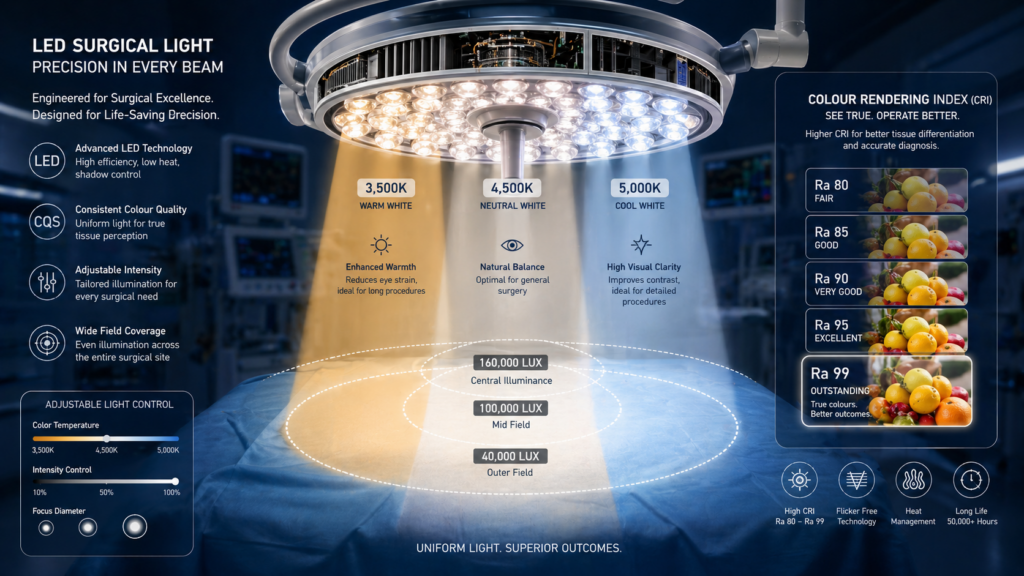
When hospital owners and clinic administrators evaluate surgical lights, three technical metrics appear on every specification sheet: lux, CRI, and color temperature. These numbers are not marketing language. They describe how much light reaches the surgical field, how accurately that light reveals tissue color, and whether the hue of that light supports or undermines a surgeon’s visual precision.
Getting these three parameters wrong is not just a purchasing error. It is a clinical risk. A surgical light with poor color rendering can mask the subtle difference between healthy and compromised tissue. One that is too dim reduces a surgeon’s ability to work precisely in deep cavities. One with an inappropriate color temperature will cause progressive eye fatigue during long procedures.
This guide explains all three metrics in plain technical language so hospital decision-makers can evaluate specifications confidently, compare products fairly, and make purchases that serve clinical teams over the long term.
What Is Lux in Surgical Lighting?
Lux is the unit of illuminance. It measures how much visible light falls on a surface per unit area. In surgical lighting, lux tells you how bright the field of view is at the operating site.
In operating theatre specifications, two lux values matter most:
- Central illuminance (Ec): The maximum light density at the centre of the surgical field — where the surgeon’s focus is most concentrated and where visibility must be at its peak.
- Peripheral illuminance (Ep): The light level at the edges of the field. This value is equally important because a sharp drop-off between the bright centre and dark periphery forces the surgeon’s eyes to constantly readjust, accelerating fatigue.
IEC 60601-2-41 — the international standard governing surgical luminaires — sets the minimum central illuminance at 40,000 lux, with the maximum ceiling at 160,000 lux. High-performance LED surgical lights routinely deliver central illuminance values at the upper end of this range, providing surgeons with an intensely lit, clearly defined operating field.
However, raw lux alone does not tell the full story. A fixture could deliver 100,000 lux of poorly coloured light and still make it harder to read tissue accurately. That is where CRI comes in.
What Is CRI and Why Does It Matter in Surgery?
The Color Rendering Index (CRI) measures a light source’s ability to accurately reproduce the natural colours of the objects it illuminates, compared to a reference light source. It is expressed as an Ra value, ranging from 0 to 100.
In everyday commercial spaces, an Ra of 80 is generally considered acceptable. In surgery, that threshold is far too low. Surgeons must be able to distinguish subtle differences in tissue shade, identify vascular structures, spot signs of necrosis or bleeding, and navigate anatomical planes that differ in colour by just a few shades.
For clinical and surgical settings, an Ra of 90 or above is the accepted minimum. Diagnosis, laboratory, surgical, and treatment areas should all be lit to CRI 90+, while non-clinical and non-surgical spaces may operate at CRI 80+. High-end surgical lights regularly exceed Ra 95, and some specialist units achieve Ra 99, providing near-perfect colour fidelity across the entire surgical field.
Ra vs. R9 — The Full Picture of Color Rendering
Ra is an average of how well a light source renders a set of standard test colours. However, a high Ra alone does not guarantee that a light renders red tones accurately — and red accuracy matters enormously in surgery because blood, vascular tissue, and organs are predominantly red.
The R9 value is the individual rendering score for saturated red. A surgical light can have a strong Ra score but a weak R9, which means it will still distort how blood and tissue appear. When evaluating surgical light specifications, always check both Ra and R9 together.
Clinical lighting references state that all luminaires in a single area should have the same CRI values to avoid inconsistency across the field.
What Is Color Temperature in Surgical Lights?
Color temperature, expressed in Kelvin (K), describes the hue or visual tone of the light a fixture emits. Lower Kelvin values produce warmer, more yellowish light. Higher values produce cooler, more daylight-like light with a bluish tint.
Surgical lights are specifically engineered to operate in the colour-neutral range between 3,000K and 6,700K. This band provides illumination that supports accurate tissue identification and clinical visibility without tilting too warm or too cool.
Within that range, different temperature settings serve different clinical needs:
Warm vs. Cool: Which Is Right for Your OR?
There is no single definitive answer backed by strong scientific consensus. Current guidance indicates that color temperatures around 3,800K give a more yellowish, peaceful light that works well for reddish tissues, while temperatures around 4,500K provide whiter, cooler tones. Both reliably support tissue colour restitution, and the practical choice often depends on surgical specialty, surgeon preference, and procedure duration.
The most clinically flexible approach is to specify surgical lights with adjustable color temperature — typically spanning 3,500K to 5,000K — so the team can optimise the setting for each procedure.
How Lux, CRI, and Color Temperature Work Together
These three metrics are interdependent. A surgical light is only as clinically effective as its weakest parameter.
Consider the following scenario: A hospital installs a fixture with excellent central illuminance — 120,000 lux — but the CRI is 82 and color temperature is fixed at 6,500K. The surgical field will be extremely bright, but surgeons will struggle to distinguish tissue colours accurately. The cool, harsh light may also accelerate eye fatigue during long procedures.
Conversely, a fixture with CRI 97 and ideal color temperature but inadequate lux output cannot illuminate deep surgical cavities effectively. A perfectly rendered image of tissue that the surgeon cannot see clearly is no help.
The clinical benchmark that best surgical lights try to achieve is:
- Lux: 40,000–160,000 lux (Ec) per IEC 60601-2-41
- CRI (Ra): 90 minimum; 95–99 for high-performance units
- R9 score: As high as possible; check it independently from Ra
- Color Temperature: 3,500K–5,000K, preferably adjustable
- Illuminance uniformity: Strong peripheral illuminance relative to central to reduce the eye’s adaptation load
IEC 60601-2-41: The Standard That Governs These Metrics
IEC 60601-2-41 is the primary international standard for surgical luminaires. It defines performance requirements including minimum and maximum central illuminance, illuminance uniformity ratios, colour rendering, and radiant energy limits.
Hospital administrators specifying emergency department procedure lights or operating theatre surgical lights should confirm that their selected luminaires comply with IEC 60601-2-41. This standard provides a vendor-neutral benchmark that allows a fair and objective comparison between products from different manufacturers.
For hospitals in India, NABH accreditation planning should be paired with IEC-based technical standards for surgical luminaires, because accreditation frameworks generally do not prescribe specific lux or CRI values in detail.
Common Mistakes When Buying Surgical Lights
Hospital buyers evaluating surgical lights for operation theatres or emergency departments often make a handful of avoidable errors:
- Buying on lux alone. A high lux number is meaningless if CRI and color temperature are not also verified from the data sheet.
- Ignoring R9. Checking Ra without checking R9 leaves a critical gap in colour fidelity evaluation, especially for surgical applications where red tissue accuracy is non-negotiable.
- Choosing a fixed color temperature. Fixed-temperature units eliminate the surgeon’s ability to adapt the light for different procedures and personal comfort.
- Overlooking uniformity ratios. The ratio between central and peripheral illuminance matters as much as peak lux for reducing surgeon eye fatigue over time.
- Skipping IEC compliance checks. Vendors may provide headline numbers without full IEC 60601-2-41 certification. Always request compliance documentation.
- Underspecifying backup power. In an emergency or procedure setting, surgical lights must remain operative during normal power failure. Confirm circuit assignment and runtime.
For an in-depth comparison of energy-efficient surgical light options for operation theatres, refer to the Hospilights guide on energy-efficient surgical lights for operation theatres. Hospilights also recently exhibited the M7 LED surgical light series at HOSPI Hyderabad — see the full HOSPI Hyderabad Booth M7 exhibition overview for product context.
Frequently Asked Questions
What does lux mean in surgical lighting?
Lux is the unit of illuminance that measures how much light falls on the surgical field. IEC 60601-2-41 sets the performance range for surgical lights between 40,000 and 160,000 lux at the centre of the field. More lux means more light at the operating site, but raw lux should always be read alongside CRI and color temperature for a complete clinical assessment.
What CRI is best for surgical lights?
Surgical and clinical environments should use lighting with a CRI of 90 or above. High-performance surgical lights commonly reach Ra 95 to Ra 99. Buyers should also check the R9 value specifically, as this measures accurate rendering of red tones — which are critical for distinguishing tissue, blood, and vascular structures.
What is the best color temperature for an operating room?
Most surgical lighting guidance points to a range of 4,000K to 5,000K as the broadly suitable zone for operating rooms because it closely mirrors natural daylight and supports accurate color perception. Adjustable color temperature between 3,500K and 5,000K is generally considered the most clinically flexible specification.
Is a higher lux output always better in surgery?
Not necessarily. IEC 60601-2-41 sets an upper limit of 160,000 lux. Excessively high lux without proper uniformity can actually create a harsh, uncomfortable field and worsen peripheral visibility. Uniformity — the balance between central and peripheral illuminance — matters as much as the peak value.
Why do some surgical lights allow color temperature adjustment?
Adjustable color temperature allows the surgical team to match the light hue to the specific procedure and surgeon’s preference. Warmer settings reduce eye fatigue during long procedures while cooler settings improve fine tissue differentiation for specialties like vascular or plastic surgery.
What is R9 and why is it important in surgical lighting?
R9 is the individual color rendering score for saturated red within the CRI measurement system. Because blood, vascular tissue, and internal organs are predominantly red, a high R9 value confirms that the surgical light will reproduce those tones accurately. A light with a high Ra but a low R9 can still misrepresent critical tissue colours.
Conclusion
Lux, CRI, and color temperature are the three pillars of surgical light performance. Hospital owners who understand what these numbers mean — and what to verify in a data sheet — are far less likely to make a purchase that underperforms in the operating theatre.
Key takeaways:
- Lux measures brightness at the field. The clinical range per IEC 60601-2-41 is 40,000–160,000 lux.
- CRI measures colour accuracy. Surgical environments need Ra 90+, and R9 should always be checked separately.
- Color temperature determines visual hue. 3,500K–5,000K adjustable range is the most flexible and clinically sound specification.
- All three must be strong simultaneously. A high score on one metric does not compensate for weakness in another.
To explore compliant, high-performance surgical lighting options for operation theatres and emergency departments, visit Hospilights, review the energy-efficient surgical lights guide, and browse the M7 LED surgical light series for product specifications.