Setting Up a New
Operation Theatre:
Complete Equipment Checklist
Everything you need to plan, equip, and commission a fully compliant operation theatre — from lighting to anaesthesia, with real cost estimates.
Setting up a new Operation Theatre is one of the most critical — and most complex — investments a hospital can make. Every equipment decision directly impacts patient outcomes. This guide covers every category you need, with checklists, cost estimates, and links to expert resources from Hospilights.
OT Layout & Infrastructure Basics
Before any equipment enters the room, your OT must be built to specification. Even the best surgical table is ineffective in a poorly designed space.
Minimum OT Room Dimensions (NABH Standards)
- General Surgery OT: Minimum 400 sq. ft (37 sq. m)
- Cardiac/Neurosurgery OT: Minimum 600 sq. ft (56 sq. m)
- Minor OT/Procedure Room: Minimum 200 sq. ft
- Ceiling Height: Minimum 3 metres (for ceiling-mounted lights and booms)
- Ventilation: Positive pressure with HEPA filtration (Class 100/ISO 5 for major OT)
Infrastructure Checklist
- Laminar Airflow (LAF) System installed and validated
- Dedicated electrical supply with UPS backup (minimum 5 KVA per OT)
- Medical gas pipeline — Oxygen, N₂O, Medical Air, Vacuum
- Anaesthesia gas scavenging system (AGSS)
- Non-slip, anti-static flooring (epoxy or vinyl)
- Scrub sink area with elbow-operated taps outside OT
- Separate clean and dirty corridors
OT Lighting — The Most Critical Equipment Decision
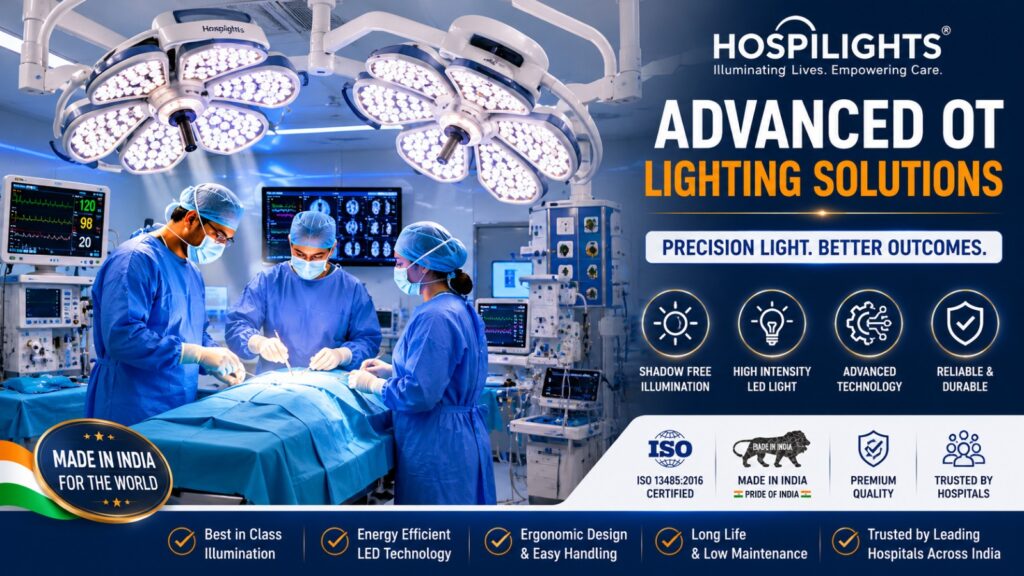
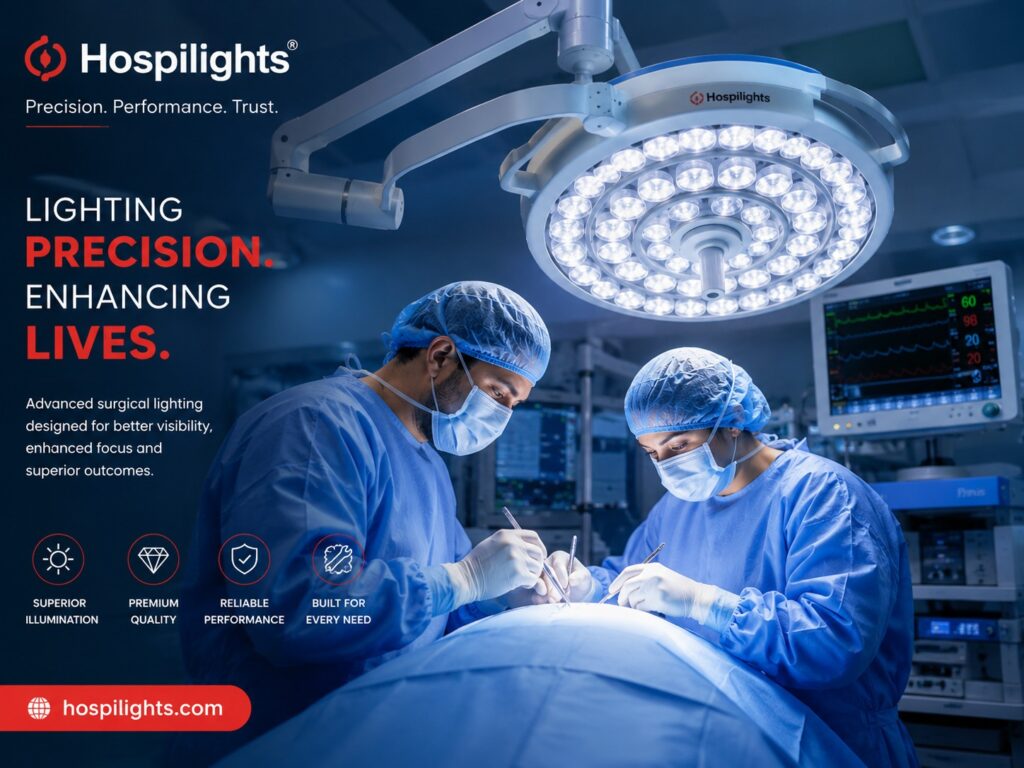
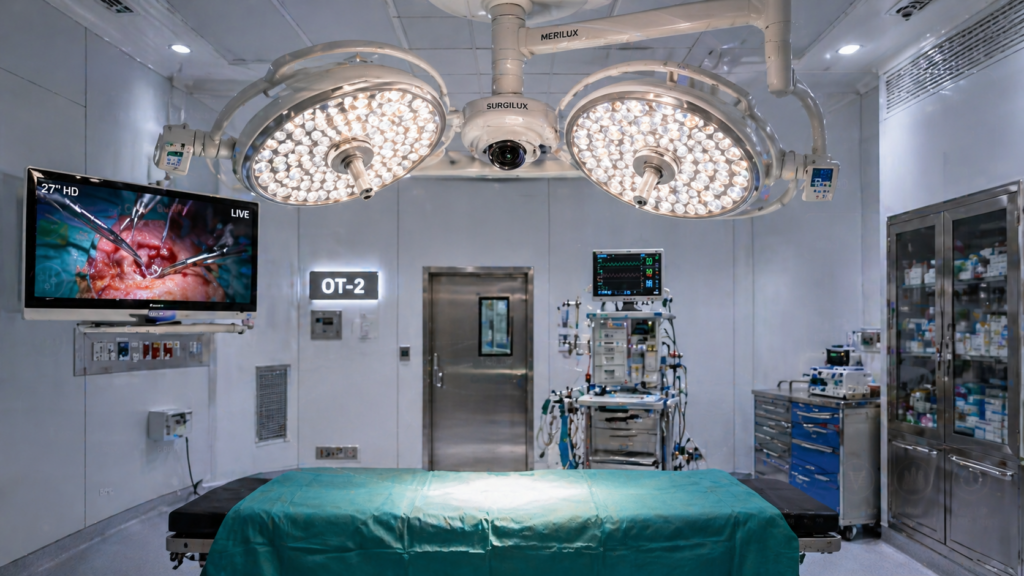
Operation Theatre lighting is arguably the single most important equipment category. Poor lighting causes eye strain, increases procedure time, and can contribute to surgical errors. This is an area where cutting costs is never appropriate.
Types of OT Lights You Need
- Main Surgical Light (Ceiling-Mounted): LED, shadowless, minimum 160,000 lux intensity, CRI ≥ 95
- Satellite/Auxiliary Light: For deep cavity illumination in thoracic, abdominal, or spinal procedures
- Examination Light: For pre/post-procedure examination in the OT
- Ambient OT Room Lighting: Dimmable LED panels, minimum 500 lux at floor level
- Emergency Backup Lighting: Battery-backed LEDs activating within 0.5 seconds of power failure
OT Light Specifications Checklist
- LED technology (50,000+ hours vs 2,000 for halogen)
- Adjustable colour temperature: 3,500K–5,000K
- Shadowless design with ≥ 8 light heads
- Sterile handle for intra-operative repositioning
- Camera integration port for HD video documentation
- Ceiling pendant/boom mounting with integrated gas and electrical outlets
Surgical Tables & Positioning Equipment
The operating table is the centrepiece of your OT. It must accommodate your surgical specialities, withstand heavy use, and provide precise positioning to reduce complications.
Types of Surgical Tables
- General Surgery Table: Multi-section, electrically adjustable, carbon fibre top for intraoperative X-ray
- Orthopaedic Table: With traction and fracture attachments, lateral positioning supports
- Gynaecology/Obstetric Table: Lithotomy position capability, adjustable leg holders
- Neurosurgery Table: Extra-long, head attachment compatible, prone positioning support
- Cardiac Surgery Table: Radiolucent, flat profile, steep Trendelenburg (min. 35°)
Key Specifications Checklist
- Weight capacity: Minimum 250 kg (bariatric tables: 400+ kg)
- Electrically operated height adjustment: 450mm–1050mm range
- Trendelenburg and reverse Trendelenburg: ±35°
- Lateral tilt: ±20°
- Carbon-fibre or radiolucent tabletop
- Battery backup — minimum 8 hours for power failure scenarios
- Anti-decubitus, easy-clean mattress surface
Anaesthesia Equipment
Anaesthesia equipment requires the most rigorous selection process of any OT category. Equipment failure here is immediately life-threatening. Always purchase from authorised, service-certified vendors.
Core Anaesthesia Workstation
- Anaesthesia Machine with built-in ventilator (Volume-Controlled, Pressure-Controlled, SIMV modes minimum)
- Integrated vaporisers: Sevoflurane, Isoflurane (add Desflurane for cardiac/neuro)
- Breathing circuits: reusable silicone or single-use disposable
- Soda lime CO₂ absorber canister
- Bag-mask ventilation unit (AMBU bag) as emergency backup
- Anaesthesia gas scavenging system (AGSS) connection
Airway Management Equipment
- Video Laryngoscope (GlideScope or equivalent) — essential for difficult airways
- Flexible fibreoptic bronchoscope
- Laryngeal Mask Airways (LMA): sizes 1–5
- Endotracheal tubes: various sizes (cuffed and uncuffed)
- Cricothyrotomy kit for emergency surgical airway
Patient Monitoring Systems
Intraoperative monitoring is non-negotiable. Modern OTs require continuous, multi-parameter monitoring with integrated alarms and documentation capability.
Intraoperative Monitoring Checklist
- Multi-parameter patient monitor (ECG, SpO₂, NIBP, EtCO₂, Temperature, IBP)
- Invasive Blood Pressure (IBP) monitoring for cardiac/major vascular cases
- Bispectral Index (BIS) monitor for depth of anaesthesia
- Defibrillator/AED — accessible within 30 seconds from any OT position
- Infusion pumps (syringe and volumetric) — minimum 4 per OT
- Blood warmer for high-volume transfusion cases
- Ceiling-mounted monitor arms for anaesthesiologist's display
- HIS integration terminal and printer for intraoperative reports
Surgical Instruments & Specialty Equipment
Surgical instruments vary by speciality. Below is a general-purpose OT instrument set plus commonly required specialty additions.
General Surgery Basic Set
- Scalpel handles (sizes 3, 4, 7) with blade dispenser
- Haemostatic clamps: Mosquito, Kelly, Rochester — set of 12 each
- Retractors: Langenbeck, Deaver, Balfour self-retaining
- Electrosurgical unit (ESU / diathermy machine) — monopolar and bipolar
- Suction machine (surgical grade, with aspirator tips)
- Mayo stand and instrument trolleys
Laparoscopy / Minimally Invasive Surgery Set
- 30° and 0° rigid laparoscope (10mm)
- CO₂ insufflator with high-flow capability (35 L/min)
- Full HD or 4K laparoscopy camera system with monitor
- Laparoscopic instrument set: graspers, scissors, clip applier, dissector
- Vessel sealing device (LigaSure or equivalent)
- Laparoscopy tower with electrosurgery integration
Sterilisation & Infection Control Equipment
Surgical site infections (SSIs) are among the most preventable hospital-acquired complications. Your sterilisation setup is as important as your surgical instruments.
- Autoclave (Steam Steriliser): 134°C — minimum 45L capacity
- Flash steriliser (rapid cycle for urgent instruments)
- Ultrasonic cleaner for instrument pre-cleaning
- Washer-disinfector for reusable instrument processing
- Chemical indicator strips and biological indicator vials
- Sterile storage cupboards with positive-pressure filtered air
- Single-use disposable drapes and gowns (minimum 2 weeks buffer stock)
- Surgical hand scrub system with chlorhexidine dispensers at scrub sinks
OT Setup Cost Estimates (India, 2025)
Realistic cost breakdown for a standard 400 sq. ft General Surgery OT in India. Costs vary by brand tier and city.
| Equipment Category | Estimated Cost Range (INR) | Priority |
|---|---|---|
| OT Surgical Lighting (LED, double dome) | ₹2,50,000 – ₹12,00,000 | ⬤ Critical |
| Operating Table (electric, general surgery) | ₹2,00,000 – ₹8,00,000 | ⬤ Critical |
| Anaesthesia Workstation (with ventilator) | ₹4,00,000 – ₹20,00,000 | ⬤ Critical |
| Multi-Parameter Patient Monitor | ₹80,000 – ₹4,00,000 | ⬤ Critical |
| Electrosurgical Unit (Diathermy) | ₹60,000 – ₹3,00,000 | ⬤ Critical |
| Laparoscopy Tower + Instruments | ₹5,00,000 – ₹20,00,000 | ◆ High |
| Defibrillator / AED | ₹80,000 – ₹2,50,000 | ⬤ Critical |
| Suction Machine | ₹20,000 – ₹80,000 | ⬤ Critical |
| Infusion Pumps (×4) | ₹80,000 – ₹3,20,000 | ◆ High |
| Surgical Instruments (basic set) | ₹1,00,000 – ₹4,00,000 | ⬤ Critical |
| Autoclave / Steriliser | ₹60,000 – ₹3,00,000 | ⬤ Critical |
| OT Boom / Pendant System | ₹1,50,000 – ₹8,00,000 | ◆ High |
| Infrastructure (LAF, MGPS, electrical) | ₹8,00,000 – ₹25,00,000 | ⬤ Critical |
| TOTAL (estimated range) | ₹27,30,000 – ₹1,13,50,000 | Full General OT |
Regulatory & Compliance Checklist
Before your OT sees its first patient, ensure full regulatory compliance. Non-compliance can result in licence cancellation — and, more critically, patient harm.
- NABH / NABL Pre-assessment completed
- Medical Device Act registration for all Class C/D devices
- State PCPNDT registration (if gynaecology/obstetrics OT)
- Fire Safety NOC and firefighting equipment in-place
- Biomedical waste management system operational (MoEFCC compliance)
- Medical gas certification from approved testing body
- Electrical safety audit completed
- Preventive Maintenance Contracts (PMCs) signed for all critical equipment
- Staff training records for anaesthesia machines, defibrillators, and ventilators
Getting Your OT Setup Right the First Time
Setting up a new Operation Theatre is a significant capital investment — but more importantly, it's a commitment to patient safety. Every decision, from the surgical light overhead to the anaesthesia machine beside the table, contributes to outcomes that matter.
The most common mistakes new hospitals make: underinvesting in lighting and anaesthesia equipment, choosing unserviceable brands with no local AMC support, and failing to future-proof their OT for minimally invasive procedures.
At Hospilights, we've supported 500+ hospital OT setups across India — from 20-bed nursing homes to 500-bed tertiary care hospitals. We offer end-to-end turnkey OT solutions, from equipment supply and installation to NABH documentation support.
Ready to Set Up Your Operation Theatre?
From surgical lighting to full OT turnkey solutions, Hospilights has helped 500+ hospitals get it right the first time.
Light post style with image 3
Keep your blog section simple modern and precise.