LED vs Halogen Surgical Lights - Which is Better for Your Hospital?
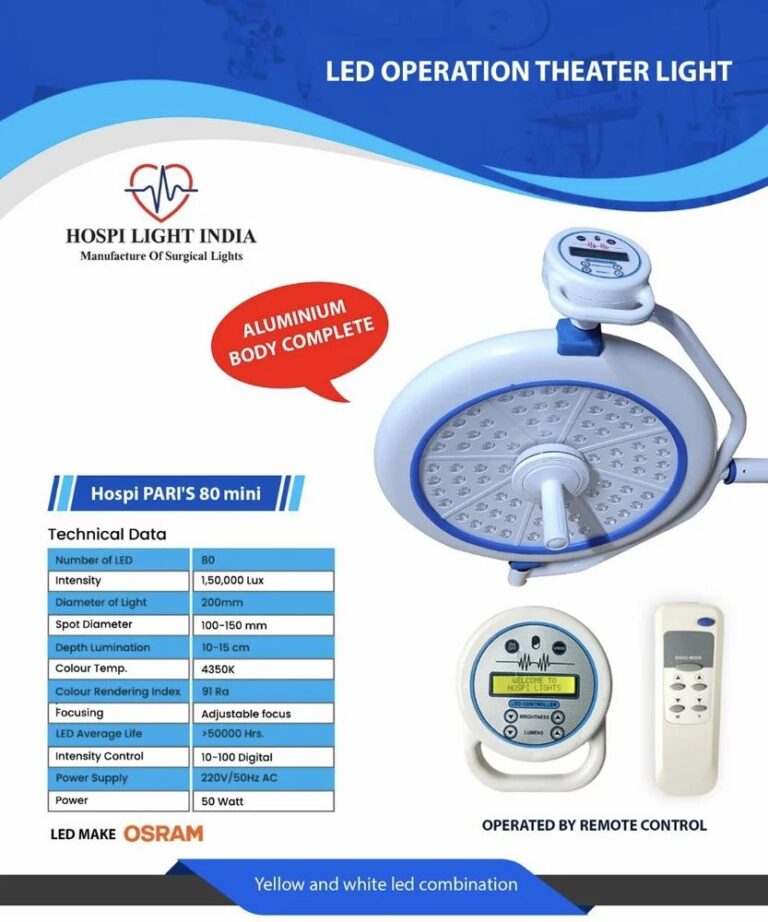
Introduction : Get to know more About Led Vs Halogen Surgical Lights
If you’re upgrading your hospital’s surgical lighting or setting up new operation theatres, you’ll face a fundamental choice: LED or halogen surgical lights?
Just a decade ago, halogen was the standard technology in most operation theatres worldwide. Today, LED technology has revolutionized surgical lighting, and the majority of new installations now choose LED. However, halogen lights are still available and significantly cheaper upfront, making some hospitals question whether the LED premium is worth it.
This comprehensive comparison examines both technologies across every critical dimension—performance, cost, lifespan, energy efficiency, heat output, and more. By the end, you’ll understand exactly why LED has become the preferred choice for modern hospitals, and in what limited scenarios halogen might still be considered.
Technology Overview
Halogen Surgical Lights: The Traditional Choice
Halogen lights work by passing electric current through a tungsten filament surrounded by halogen gas. The filament heats to extremely high temperatures (around 3000°C), producing intense white light.
How They Work:
- Tungsten filament glows when heated
- Halogen gas regenerates evaporated tungsten back onto filament
- Reflectors direct light toward surgical field
- Multiple bulbs provide required intensity
History: Halogen surgical lights replaced older incandescent technology in the 1980s-90s and became the standard for operation theatres worldwide until LED technology matured in the 2010s.
LED Surgical Lights: Modern Technology
LED (Light Emitting Diode) surgical lights use semiconductor technology to produce light through electroluminescence—a completely different process than heating filaments.
How They Work:
- Electricity passes through semiconductor material
- Electrons release energy as photons (light)
- Multiple LEDs (30-80+ per dome) arranged in arrays
- Each LED produces focused, directional light
- Advanced optics and reflectors optimize distribution
Development: While LED technology has existed since the 1960s, high-intensity LEDs suitable for surgical applications only became viable in the mid-2000s. Rapid improvements in LED efficiency, color quality, and cost have made LED surgical lights the new standard.
Head-to-Head Comparison
1. Illumination Quality and Intensity
LED Surgical Lights:
- Lux Output: 80,000-160,000+ lux (single to twin dome)
- Light Distribution: Highly uniform across surgical field
- Adjustability: Precise intensity control (typically 10-100%)
- Focus Quality: Sharp, well-defined light field with adjustable diameter
- Consistency: Maintains constant output throughout lifespan
- Instant On: Full brightness immediately upon switching on
Halogen Surgical Lights:
- Lux Output: 60,000-120,000 lux (single to twin dome)
- Light Distribution: Good but can have hot spots
- Adjustability: Limited intensity control (often just high/low)
- Focus Quality: Good but less precise than LED
- Consistency: Output degrades as bulbs age (loses 20-30% brightness)
- Warm-up Time: Requires 30-60 seconds to reach full brightness
Winner: LED – Superior intensity, uniformity, adjustability, and consistency
Impact on Surgery:
- Surgeons report better tissue visualization with LED
- More precise control of lighting conditions
- Consistent performance throughout surgery
- Better illumination in deep cavities
2. Color Rendering Index (CRI) and Color Temperature
Color accuracy is critical for distinguishing between tissue types, blood vessels, and pathology.
LED Surgical Lights:
- CRI: 90-98 (excellent color accuracy)
- Color Temperature: Stable 4000-4500K (neutral white)
- Color Consistency: Remains constant throughout LED lifespan
- Adjustability: Premium models offer adjustable color temperature
- Tissue Appearance: Natural, accurate colors
Halogen Surgical Lights:
- CRI: 95-100 (excellent when new)
- Color Temperature: 3200-3400K (warm white/yellowish)
- Color Consistency: Shifts as bulb ages (becomes more yellow)
- Adjustability: Fixed color temperature
- Tissue Appearance: Warmer tones, may affect color judgment
Winner: LED – Better color temperature for surgery with superior long-term consistency
Clinical Significance:
- LED’s neutral white (4000-4500K) is preferred by surgeons for accurate tissue visualization
- Halogen’s warm tone (3200-3400K) can make tissue appear more yellow
- LED maintains color consistency; halogen shifts over time
- Studies show surgeons prefer LED color for precision work
3. Energy Consumption and Operating Costs
This is where LED shows dramatic superiority.
LED Surgical Lights:
- Power Consumption: 40-80W per dome
- Daily Energy (8 hours): 0.32-0.64 kWh
- Annual Energy Cost: ₹820-₹1,640 per light (@₹7/kWh)
- 10-Year Energy Cost: ₹8,200-₹16,400
- Efficiency: 80-90% of energy converts to light
Halogen Surgical Lights:
- Power Consumption: 150-300W per dome
- Daily Energy (8 hours): 1.2-2.4 kWh
- Annual Energy Cost: ₹3,066-₹6,132 per light (@₹7/kWh)
- 10-Year Energy Cost: ₹30,660-₹61,320
- Efficiency: Only 10-15% of energy converts to light (rest is heat)
Energy Savings with LED: ₹22,000-₹45,000 per light over 10 years
Winner: LED – Uses 60-75% less energy
Hospital-Wide Impact: A 200-bed hospital with 6 operation theatres:
- LED total cost (10 years): ₹98,400
- Halogen total cost (10 years): ₹367,920
- Annual savings with LED: ₹26,950
- 10-year savings: ₹2,69,500
Plus additional savings on air conditioning (less heat to remove).
4. Heat Output and Surgical Field Temperature
Excessive heat from surgical lights is more than uncomfortable—it’s a patient safety issue.
LED Surgical Lights:
- Heat Output: 30-50 mW/cm² at surgical field
- Surface Temperature: 40-50°C (warm but not hot)
- Heat Mechanism: Minimal infrared radiation
- Patient Impact: Negligible heat felt by patient
- Surgeon Comfort: Cool operating conditions
- Tissue Effect: No desiccation of surgical site
Halogen Surgical Lights:
- Heat Output: 120-180 mW/cm² at surgical field
- Surface Temperature: 70-90°C (very hot, burn risk)
- Heat Mechanism: High infrared radiation (60-70% of energy)
- Patient Impact: Significant heat on exposed tissue
- Surgeon Comfort: Uncomfortable, causes perspiration
- Tissue Effect: Can cause tissue drying and thermal damage
Winner: LED – 70-85% less heat output
Clinical Impact:
- With Halogen: Surgeons report discomfort within 15-30 minutes, increased perspiration, need for frequent breaks
- With LED: Surgeons comfortable throughout long procedures
- Patient Safety: LED reduces risk of thermal burns during long surgeries
- Infection Control: Less surgeon perspiration = lower contamination risk
Additional Benefit: Lower air conditioning costs
- Halogen lights add significant heat load to OT
- Requires more powerful AC systems
- LED lights reduce cooling requirements by 30-50%
5. Product Lifespan and Bulb Replacement
LED Surgical Lights:
- LED Lifespan: 50,000-60,000 hours (L70 rating)
- Real-World Use:
- 8 hrs/day = 17+ years
- 12 hrs/day = 11+ years
- 16 hrs/day = 8+ years
- Replacement: Entire light system (not just bulbs)
- Degradation: Gradual dimming to 70% over lifespan
- Bulb Changes: None required for entire lifespan
- Maintenance: Minimal
Halogen Surgical Lights:
- Bulb Lifespan: 500-2,000 hours
- Real-World Use:
- 8 hrs/day = 2-8 months per bulb
- 12 hrs/day = 1.5-5.5 months per bulb
- 16 hrs/day = 1-4 months per bulb
- Replacement: Frequent bulb changes required
- Degradation: Sudden failure (bulb burns out)
- Bulb Changes: 1.5-6 times per year
- Maintenance: Frequent, disruptive
Winner: LED – 25-100x longer lifespan with no bulb replacements
Operational Impact:
LED Advantages:
- No bulb inventory to maintain
- No scheduled maintenance shutdowns for bulb changes
- No emergency bulb failures during surgery
- Predictable, gradual performance decline
- Lower maintenance staff workload
Halogen Challenges:
- Constant bulb replacement costs (₹8,000-₹15,000 per set)
- Risk of bulb failure during surgery
- OT downtime for bulb changes
- Need for bulb inventory management
- Higher biomedical engineering workload
10-Year Bulb Replacement Cost:
- LED: ₹0
- Halogen: ₹1,20,000-₹2,40,000 per light
6. Total Cost of Ownership (TCO)
Initial price tells only part of the story. Let’s examine 10-year TCO:
LED Surgical Light (Twin Dome) – 10 Year TCO:
- Purchase: ₹8,00,000
- Installation: ₹50,000
- Energy (10 years): ₹12,000
- Maintenance: ₹35,000
- Bulb replacements: ₹0
- Major repairs: ₹15,000
- TOTAL: ₹9,12,000 (₹91,200/year)
Halogen Surgical Light (Twin Dome) – 10 Year TCO:
- Purchase: ₹4,00,000
- Installation: ₹45,000
- Energy (10 years): ₹45,000
- Maintenance: ₹2,00,000
- Bulb replacements: ₹1,80,000
- Major repairs: ₹80,000
- Replacement (Year 6): ₹4,00,000
- TOTAL: ₹13,50,000 (₹1,35,000/year)
Winner: LED – ₹4,38,000 lower TCO over 10 years despite higher initial cost
Break-Even Point: LED pays for its higher initial cost in approximately 4.2 years through energy and maintenance savings.
Conclusion: LED Is the Clear Choice
While halogen surgical lights served the medical community well for decades, LED technology has evolved to be superior in virtually every meaningful way. Yes, LED lights cost more initially, but:
- Performance: LED provides better light quality, color accuracy, and shadow control
- Economics: LED costs less over 10 years despite higher upfront cost
- Comfort: Surgeons and patients experience significantly less heat
- Reliability: LED requires minimal maintenance with no bulb changes
- Sustainability: LED dramatically reduces energy consumption and environmental impact
The Verdict: For new operation theatres in 2026, LED surgical lights are the only sensible choice. The technology is mature, proven, and economically superior. Halogen should only be considered in very limited circumstances where immediate cost is the only consideration.
Upgrade Your Hospital to LED Surgical Lights
Hospi Lights – Leading LED Surgical Lights Manufacturer in India
Make the switch to LED technology with India’s trusted surgical lights manufacturer:
✓ Premium LED Technology: 95+ CRI, 120,000-160,000 lux
✓ Energy Efficient: 60-75% lower power consumption
✓ Long Lifespan: 50,000+ hours, no bulb replacements
✓ Cool Operation: Minimal heat output for surgeon comfort
✓ Made in India: ISO certified, competitive pricing
✓ Complete Support: Installation, training, 5-year warranty
📞 Call: +91-9810715757
📧 Email: [email protected]
🌐 Visit: www.hospilights.com
Download: Free OT Lights Evaluation Checklist PDF
Create your own
We are company who manufactures and distributes medical equipment's like OT lights , Derma chair and more
Light post style with image 3
Keep your blog section simple modern and precise.