
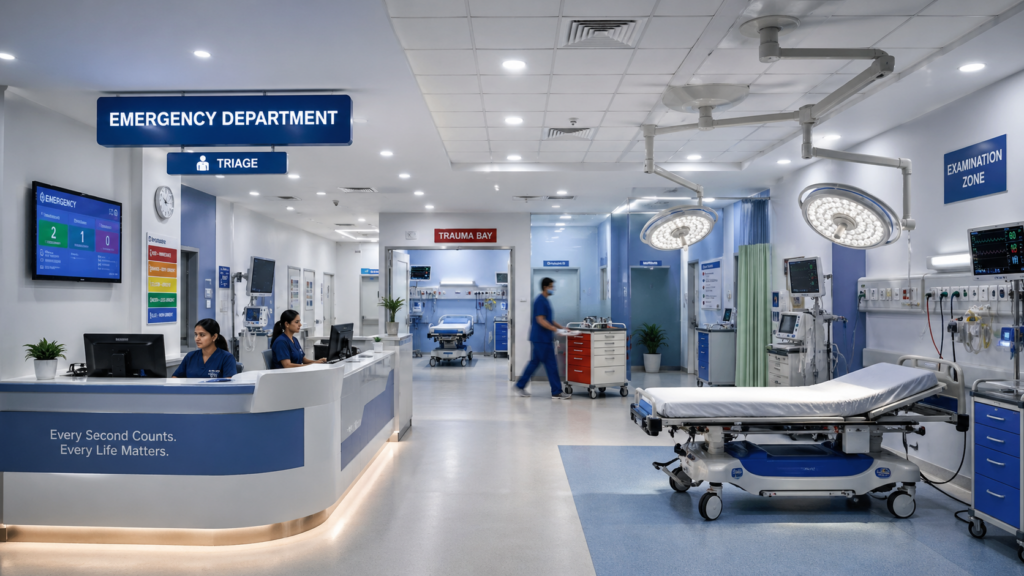
Emergency department lighting is not just about making a room bright. It has to support triage, rapid examination, trauma response, minor procedures, staff circulation, and safe egress when normal power fails.
That is why emergency room lighting should never be specified like a standard commercial interior. In healthcare facilities, emergency egress lighting is served by the life safety branch, while other lighting that must stay operative for patient care can be served by the critical branch of the essential electrical system.
For hospital owners and clinic operators in India, this topic is especially important because published research has noted that NABH and JCI accreditation do not themselves provide detailed lighting values for hospital spaces, so teams often need to align accreditation planning with broader lighting standards and equipment requirements.
This guide explains where general ambient lighting is enough, where ER surgical lights or procedure lights are needed, and what to prioritise for compliance, visibility, comfort, and long-term operating cost.
Why ED lighting is different
Emergency departments handle many visual tasks in the same footprint. Examination areas need bright, consistent light that reveals clinical signs clearly, while trauma bays benefit from shadow-free illumination similar to operating-room conditions.
At the same time, the department should not feel visually chaotic. Good hospital lighting design also improves wayfinding, reduces confusion, and helps create a calmer environment in waiting and circulation areas.
The most effective approach is layered lighting. That means treating triage, exam bays, trauma/procedure zones, nurse stations, corridors, and emergency egress as separate lighting tasks rather than forcing one fixture type to do everything.
Lighting layers to specify
Technical requirements
Colour rendering matters more in an emergency department than in most commercial spaces. General indoor projects often accept 80 CRI as a baseline, but where accurate colour appearance matters, 90 CRI and above is the better starting point.
That matters in real clinical work because staff are looking at skin tone, blood, bruising, wounds, and subtle tissue changes. Neutral white light with high colour fidelity generally makes those assessments easier than warm, low-CRI light.
Shadow control is another major requirement. Emergency department guidance notes that trauma bays should have shadow-free illumination similar to operating rooms, and recessed ambient fixtures can help reduce unwanted side-shadowing compared with suspended fixtures.
Heat at the working field also deserves attention. Modern surgical lights increasingly use LED because they consume less energy, generate less heat, and provide clearer illumination than older halogen systems, which were associated with greater eye fatigue and risk of tissue desiccation.
Emergency power performance should be specified upfront, not added later. In healthcare occupancies, the essential electrical system separates life safety and critical functions, and emergency illumination references commonly require at least 90 minutes of operation during failure of normal lighting.
Testing duration can vary by jurisdiction. For example, UK healthcare guidance commonly points to 3-hour emergency lighting duration in many installations, while NFPA-based references centre on 90 minutes, so final design should always be checked against local fire, electrical, and hospital requirements.
Compliance and design strategy
One of the biggest planning mistakes is assuming accreditation alone answers the lighting brief. Indian hospital research found that NABH and JCI do not provide specific lighting requirements, which helps explain why many hospitals still show poor compliance with prescribed lighting standards in practice.
For that reason, emergency department owners should combine accreditation planning with technical references. Useful external benchmarks include the NABH hospital standards, IEC guidance for surgical and examination luminaires, and clinical environment references such as WHO safe surgery guidance.
Energy use should also be part of the specification discussion. Hospitals run lighting for long hours, and LED-based clinical lighting is increasingly preferred because it lowers heat and operating load compared with halogen-based alternatives.
A practical emergency department spec usually works best when it follows five rules:
- Separate ambient, examination, procedure, and emergency egress lighting into distinct layers.
- Use high-CRI lighting in spaces where clinicians must judge skin, blood, and tissue accurately.
- Put dedicated shadow-free task lights in trauma, suturing, and minor-procedure zones.
- Confirm which fixtures are on life safety backup and which are on the critical branch.
- Ask vendors for photometric data, compliance documents, service support, and maintenance expectations before purchase.
How to choose ER surgical lights
Not every emergency room bay needs a surgical light. General examination cubicles usually need bright ambient light and a focused exam light, while trauma bays, resuscitation spaces, and procedure-capable rooms justify shadow-free procedure or surgical luminaires.
If your hospital is comparing LED options, start with fixture purpose rather than headline lux alone. A triage bay, a suturing room, and a resuscitation bay may all need different beam patterns, mounting methods, and backup-power strategies even when they sit in the same department.
For internal research, Hospilights can support this topic with contextual pages such as Energy-Efficient Surgical Lights for Operation Theatres, the Hospi Exhibition Hyderabad Booth M7 LED Surgical Lights page, and the main Hospilights website.
A useful buying checklist for emergency room lighting should include:
- Required use by zone: triage, examination, trauma, procedure, corridor, or exit path.
- CRI and glare control requirements for clinical visibility.
- Mounting type: recessed ambient, ceiling-mounted procedure light, wall-mounted exam light, or mobile light.
- Emergency runtime and circuit connection for life safety and critical lighting.
- Maintenance access, cleaning protocol, and vendor service responsiveness.
Frequently Asked Questions
What lux level should an emergency department have?
There is no single lux target that works for every part of an emergency department. Egress lighting references commonly call for an average of 10.8 lux and a minimum of 1.1 lux along the floor-level path of egress for 90 minutes, while procedure-capable surgical luminaires are commonly specified in the 40,000 to 160,000 lux range at the field.
Do all ER bays need surgical lights?
No. General exam areas need bright, consistent light and focused examination lighting, but trauma and resuscitation areas benefit from shadow-free illumination similar to operating-room conditions.
What CRI is best for emergency room lighting?
For spaces where clinicians must judge colour accurately, 90 CRI and above is a stronger target than the general 80 CRI commercial baseline. That helps staff distinguish skin tone, blood, bruising, and tissue detail more reliably.
Should emergency department lighting connect to backup power?
Yes. In healthcare facilities, emergency egress lighting is part of the life safety branch, while other patient-care lighting that must stay operative can be served by the critical branch, and emergency illumination references commonly require 90 minutes of backup performance.
Why is LED usually preferred over halogen for ER surgical lights?
Modern LED surgical lighting is preferred because it uses less energy, produces less heat, and gives clearer illumination than older halogen systems. Lower heat at the field also helps reduce discomfort and the risks associated with excessive irradiance during prolonged procedures.
Conclusion
Emergency department lighting works best when it is designed as a clinical system, not as a generic ceiling layout.
Key takeaways:
- Emergency departments need layered lighting because triage, trauma, circulation, and egress all have different visual and electrical requirements.
- High-CRI lighting and shadow-free task lights are especially important in trauma and procedure-capable bays.
- Emergency egress lighting must continue operating during normal power failure and should be designed around the applicable code path for your project.
- LED clinical lighting usually offers better heat, energy, and maintenance performance than halogen-based alternatives.
For top-of-funnel research, the next step is to audit your current ED by zone, identify where exam lighting ends and procedure lighting begins, and then compare fixtures against your backup-power plan, cleaning routine, and clinical workflow. You can continue that review on the Hospilights homepage, read the guide to energy-efficient surgical lights, and browse the Hyderabad booth article for related product context.